
Breast Augmentation & Mastopexy: Combined in One Surgery
You've done the research. You know what you want: more volume, a higher position, and a result that looks genuinely natural — not "done." The question isn't whether it's possible. It's whether it can be done well, and safely, in a single surgery.
The answer is yes. But it requires the right conversation.
The Numbers Behind the Demand
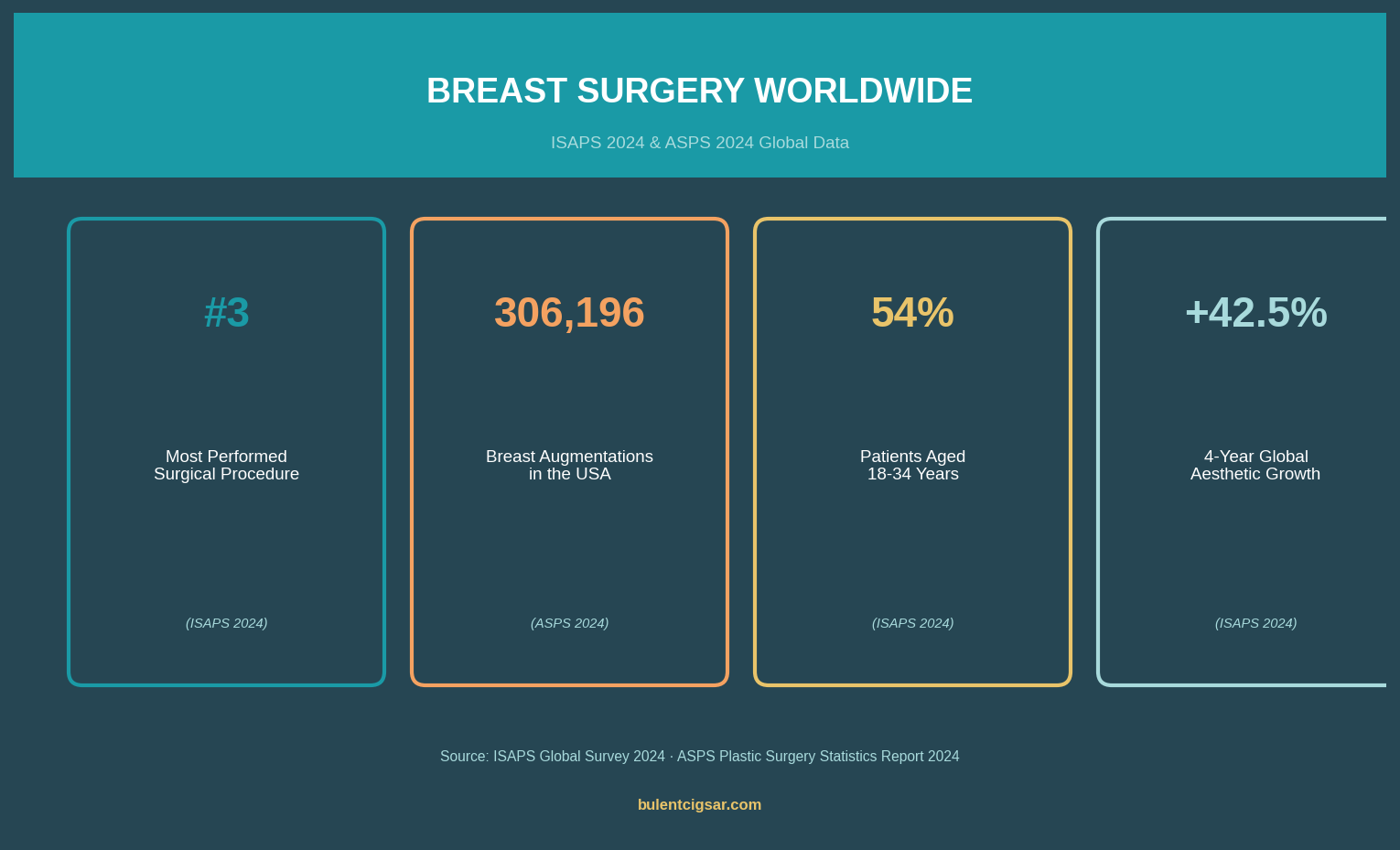
Breast surgery isn't a niche category. According to the ISAPS 2024 Global Survey, breast augmentation ranks as the 3rd most commonly performed surgical aesthetic procedure worldwide. In the United States alone, 306,196 breast augmentations and 153,616 mastopexies were performed in 2024. Globally, cosmetic procedures have grown by 42.5% over four years — and the shift toward combined, comprehensive approaches is one of the clearest trends driving that growth.
What patients want has changed. Not just bigger. Better proportioned, naturally positioned, and built to last.
The Myth We Need to Address First
"Can't I just get a larger implant and skip the lift?"
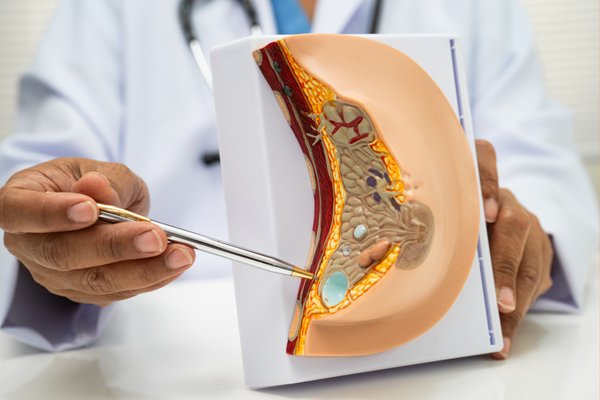
We hear this often — and it's worth being honest about. A larger implant does not correct sagging. Breast ptosis is caused by skin and ligament laxity, and adding volume doesn't resolve laxity — it adds weight that, over time, can actually accelerate drooping. As outlined in leading surgical references, lower pole laxity cannot be corrected by implant size alone. This misunderstanding leads patients toward results that fall short, and sometimes toward avoidable complications.
If both volume loss and sagging are present, the only answer that addresses both is augmentation mastopexy.
First, Where Do You Stand? The Regnault Classification
Before any surgical plan is made, the degree of ptosis must be precisely assessed. Plastic surgeons use the Regnault classification — the internationally accepted standard — to evaluate where the nipple sits in relation to the inframammary fold (IMF):
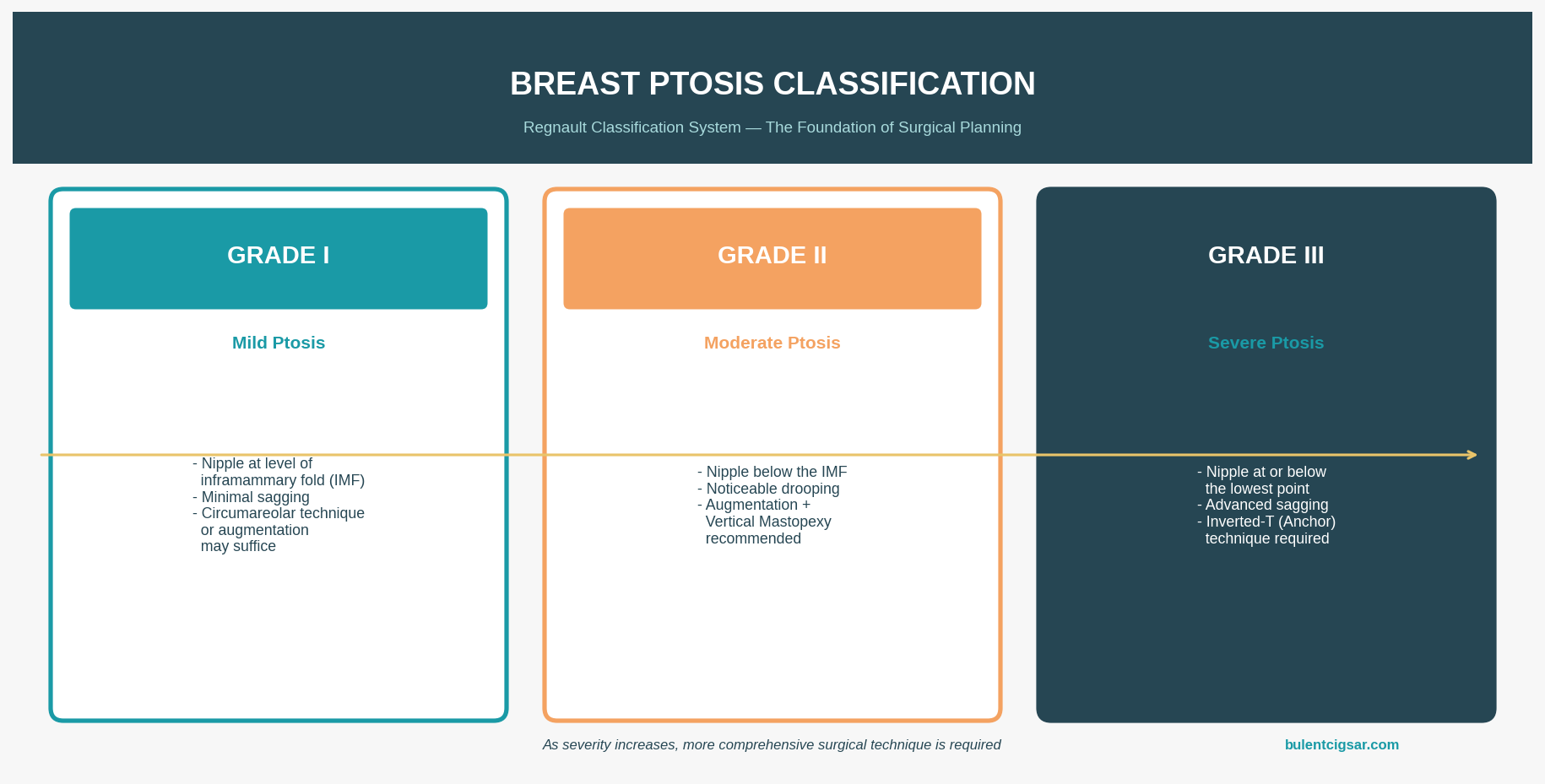
Grade I — Mild Ptosis: The nipple is at the level of the IMF. Minimal drooping; circumareolar technique or augmentation alone may suffice.
Grade II — Moderate Ptosis: The nipple has descended below the fold but sits above the breast's lowest point. Augmentation mastopexy with a vertical technique is the standard approach — and the most commonly encountered presentation.
Grade III — Severe Ptosis: The nipple is at or below the breast's lowest projection. An inverted-T or anchor pattern is often required; volume and shape are corrected simultaneously.
The grade doesn't just tell us how much lifting is needed. It determines the mastopexy technique, the scar pattern, and how the nipple-areola complex (NAC) will be repositioned — all of which must be planned before a single incision is made.
What Is Augmentation Mastopexy — and Why Is It Technically Demanding?
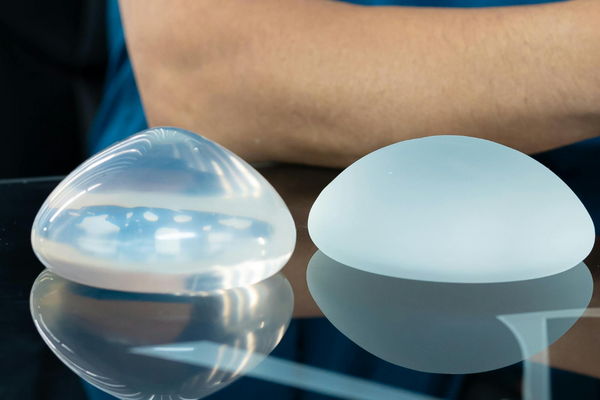
Augmentation mastopexy combines implant placement with a breast lift in a single surgical session. Two goals, one recovery. That's the appeal.
But here's what makes it challenging: mastopexy tightens and compresses the skin envelope. Augmentation stretches it with added volume. These two forces work against each other. Implant selection, pocket placement, and the mastopexy technique must be calibrated in precise relation to each other — otherwise the competing forces compromise both shape and longevity.
This is why augmentation mastopexy is consistently cited as one of the most technically demanding procedures in aesthetic breast surgery. In experienced hands, it delivers results that are genuinely transformative. But it isn't improvised.
What the Research Actually Shows
A comprehensive meta-analysis published in Plastic and Reconstructive Surgery, covering 23 studies and 4,856 cases, reported the following pooled outcomes for single-stage augmentation mastopexy:
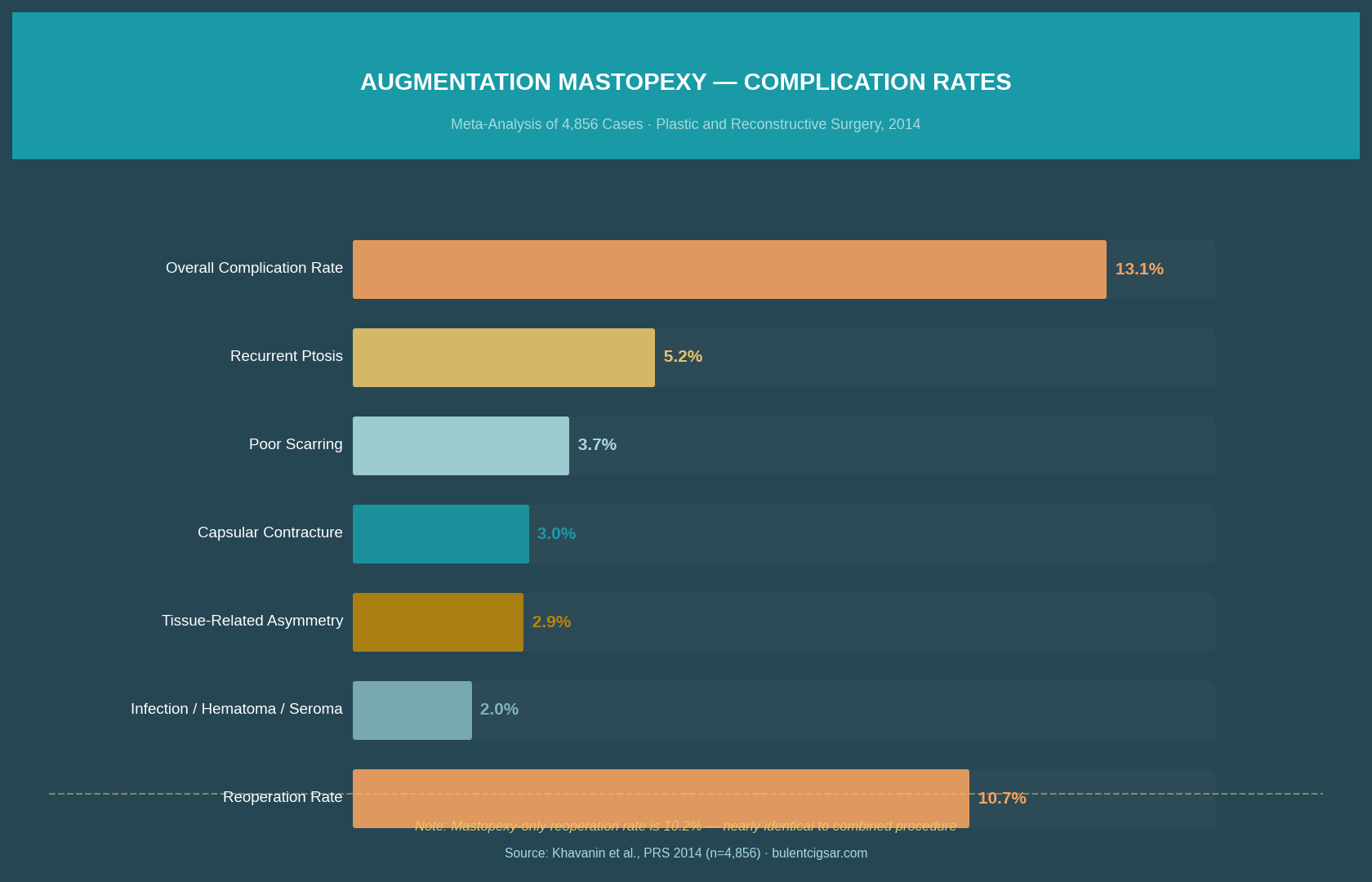
These numbers need context. The reoperation rate for mastopexy performed alone — without any augmentation — is 10.2%. In other words, combining the two procedures doesn't meaningfully change the revision risk compared to doing the lift by itself. You're not taking on additional surgical risk by addressing both concerns at once.
One Surgery or Two? The Honest Answer
This debate has defined breast surgery consultations for decades. The evidence increasingly points in one direction.
Stevens et al. reviewed 615 consecutive patients over nearly two decades of single-stage augmentation mastopexy. Their conclusion: with appropriate patient selection and a skilled surgeon, the procedure is both safe and effective. The 16.9% revision rate compared favorably with published rates for augmentation alone and mastopexy alone.
A nationwide database analysis spanning 2005 to 2018 confirmed that combined augmentation mastopexy carries no statistically significant increase in perioperative complications, reoperation, or readmission compared with augmentation-only procedures.
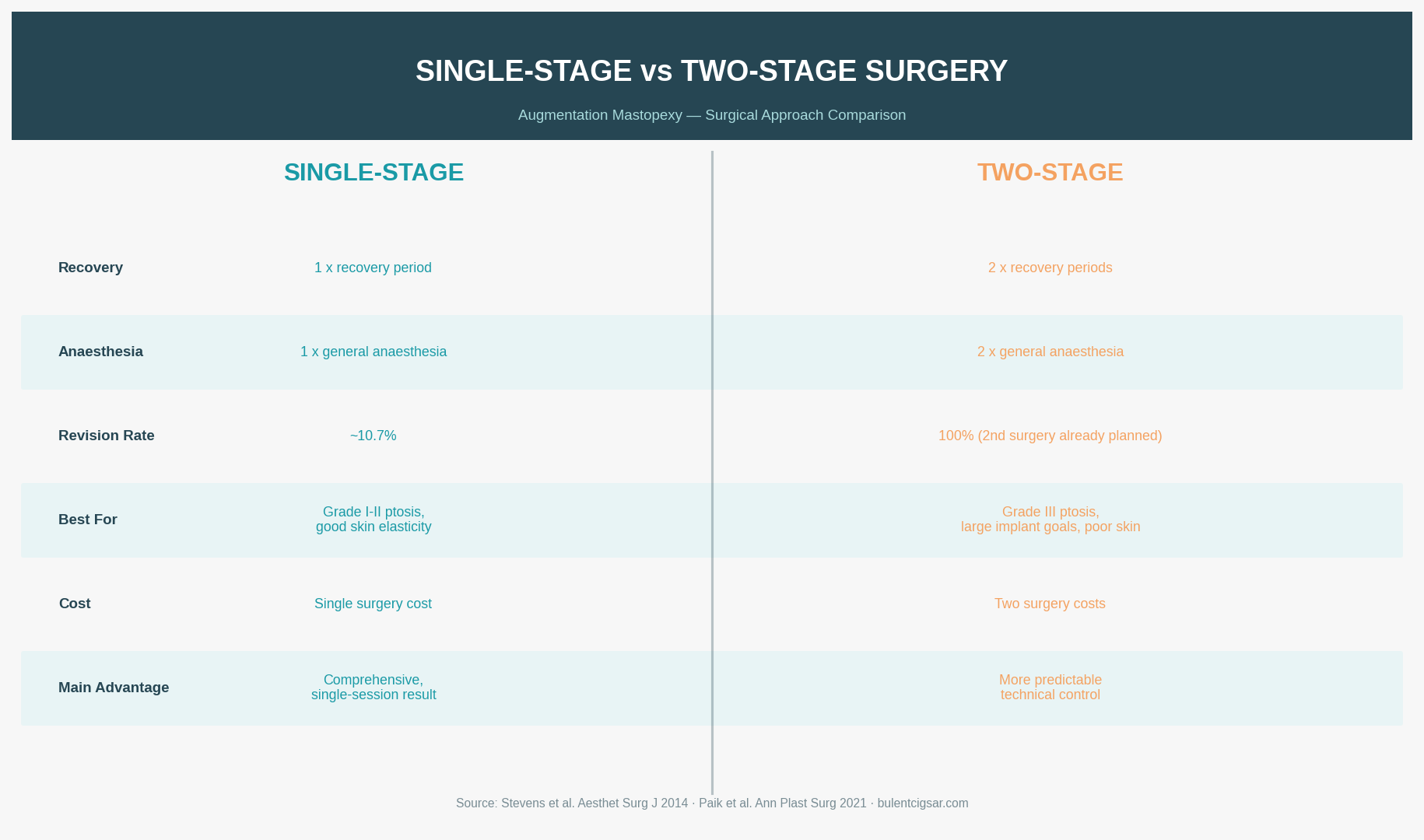
The most mathematically compelling argument for single-stage surgery: a two-stage approach has a 100% "revision" rate by definition — the second surgery is already planned. Single-stage gets you there with one recovery, one anaesthesia event, and a reoperation rate of around 10.7%.
Two-stage surgery remains the safer choice when:
Severe Grade III ptosis is present
The implant volume goal is very large
Skin elasticity is poor
Significant tissue resection is required
There's no universal answer. The right approach depends on what you're working with.
The Numbers That Matter Most: Patient Satisfaction
In a prospective outcome study of 106 patients who underwent vertical mastopexy, augmentation mastopexy, and breast reduction:
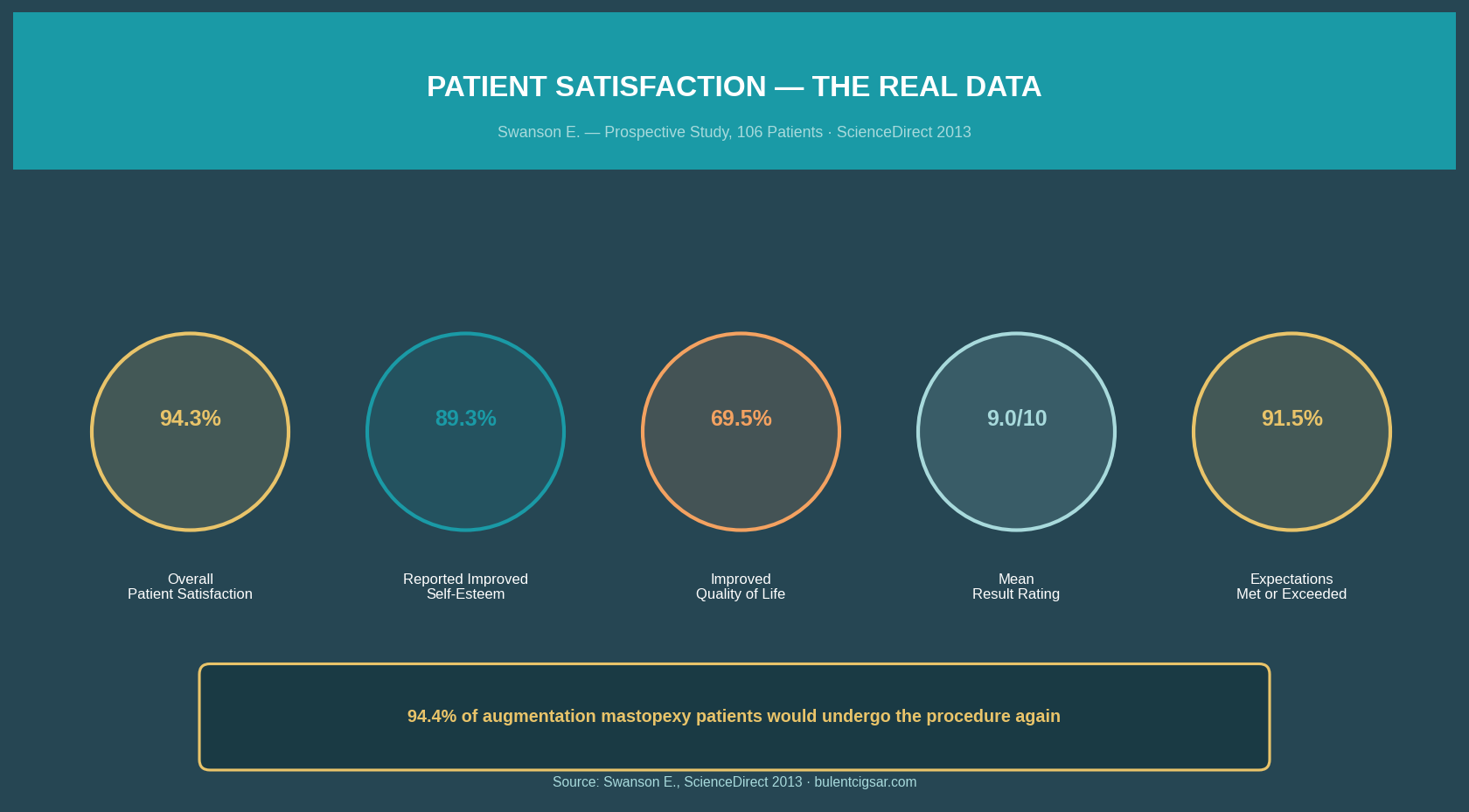
94.3% overall patient satisfaction
89.3% reported improved self-esteem
69.5% reported improved quality of life
Mean result rating: 9.0 out of 10
91.5% of augmentation mastopexy patients had their expectations met or exceeded
In a separate study, 94.4% of augmentation mastopexy patients said they would undergo the procedure again.
These aren't survey responses collected from a marketing campaign. They're data from peer-reviewed, prospective clinical research — the most rigorous kind.
How We Approach It
Every augmentation mastopexy begins with a consultation built around anatomy, not assumptions. Dr. Çığşar evaluates each case through several key parameters:
Ptosis grading: The precise nipple-to-IMF distance and lower pole laxity assessment determines both technique and scar placement.
Implant pocket: Subglandular placement offers a more natural transition in appropriate candidates with good tissue coverage. Dual plane positioning provides additional coverage in thinner patients or with larger volumes.
Mastopexy technique: Dr. Çığşar favours the vertical technique when anatomy allows — it produces consistent, lasting shape with a more limited scar footprint compared to the inverted-T pattern.
NAC repositioning: The new nipple position is calculated based on both aesthetic proportion and vascular safety. The blood supply to the nipple-areola complex is the non-negotiable constraint in planning — shape decisions come second.
Nothing is rushed. Nothing is assumed. The plan emerges from the specific patient in front of us.
Are You a Good Candidate?
Augmentation mastopexy tends to deliver its best results when:
Volume loss and ptosis coexist — neither can be fully addressed without tackling both
Changes have followed pregnancy, breastfeeding, or significant weight loss
General health is good and there are no uncontrolled medical conditions
The patient is a non-smoker, or committed to stopping at least 4–6 weeks before surgery
Expectations are realistic and grounded in a thorough consultation
Childbearing is complete — pregnancy and breastfeeding can affect long-term results
If you're still planning to have children, we'll usually recommend waiting. The results are simply more durable when the anatomy isn't going to change again.
Why Istanbul?
Turkey has become one of the world's most significant destinations for aesthetic surgery — not because of price alone, but because of the combination of surgical training, clinical infrastructure, and coordinated international patient care that Istanbul, in particular, has developed.
ISAPS data positions Turkey among the top countries for international patient volume in aesthetic procedures. Our international patients come from across Europe, the Middle East, and beyond. The process — from first contact to post-operative follow-up — is coordinated by our team in English.
Dr. Bülent Çığşar has been practicing plastic, reconstructive, and aesthetic surgery in Istanbul for over 25 years. Please contact us with any questions you may have about breast augmentation and lift procedures, or schedule an online consultation.