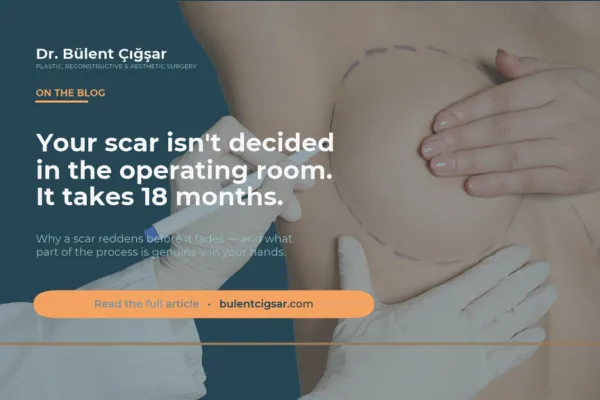
Your Scar Isn't Decided in the Operating Room. It's Decided Over the Next 18 Months.
The third month is when people panic
Most people don’t worry much about their scar in the first weeks after surgery. There are dressings, there’s swelling, everything still feels temporary. The anxiety tends to arrive around month three.
That’s when the scar is usually red, slightly raised and firm to the touch. You look in the mirror and think: is this permanent? Some patients read it as a sign that something went wrong.
It isn’t. That redness is not a failure — it’s construction. It means the body is actively rebuilding the area. And the most useful thing to know is this: what you’re looking at is not the result.
A surgical scar takes 12 to 24 months to fully mature. The hours spent in the operating room determine where the scar will be. What determines how it looks are the months that follow.
This article is about those months.
What a scar actually is
When skin is cut, the body doesn’t restore it. It repairs it. Those are two different things, and the difference explains why a scar never quite becomes ordinary skin again.
The process runs in three overlapping stages.
The first days — inflammation. The body stops the bleeding and cleans the wound. Redness, warmth and swelling are the natural consequence.
The first weeks — proliferation. Cells called fibroblasts move in and start producing collagen rapidly, while new blood vessels form to supply the area. This is why a young scar looks red and feels firm or raised: there is intense cellular activity underneath, and the tissue is unusually well supplied with blood.
The following months — remodelling. This is the longest stage, and it’s where the scar’s final character is decided. The weak, hastily laid Type III collagen is gradually replaced by stronger, more organised Type I collagen. The fibres stop sitting randomly and begin aligning along the lines of tension. The excess blood vessels regress.
That last step is why the redness fades. The colour came from the blood supply; when the vessels retreat, the colour goes with them.
A mature scar turns white or silvery because what’s left is a dense, largely bloodless mesh of collagen. It’s strong tissue — but it contains no hair follicles and no sweat glands. That’s why a scar fades, flattens and softens without ever fully becoming the skin it replaced.
The honest version: no surgery is scarless. The goal isn’t to eliminate the scar. It’s to place it well and give it the best possible chance to mature quietly.
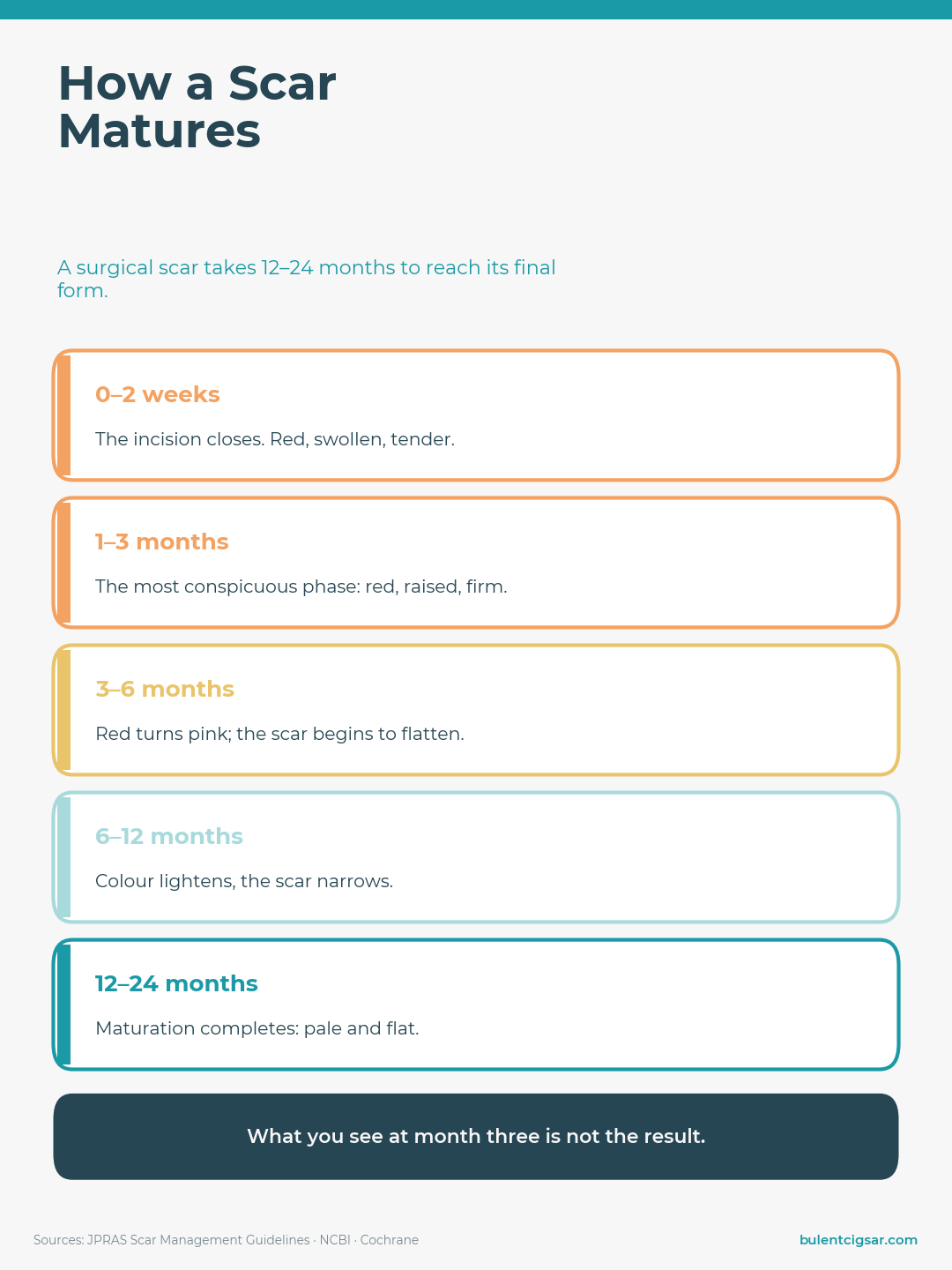
The timeline: what to expect and when
0–2 weeks. The incision closes. The line is red, slightly swollen and tender. At this point it isn’t really a scar yet — it’s a fresh wound.
1–3 months. The most conspicuous phase. Red, raised, firm, sometimes itchy. This is when most patients worry — and it’s also when healing is at its most active.
3–6 months. Red turns pink. The scar begins to flatten and soften. Visible improvement becomes obvious.
6–12 months. The colour lightens further and the scar narrows. The appearance has largely settled but isn’t final.
12–24 months. Maturation completes. The scar reaches its pale, flat, stable form.
Knowing this timeline removes a surprising amount of post-operative anxiety, because most scar worries aren’t caused by a scar healing badly. They’re caused by a scar that simply hasn’t finished healing.
The real variable is tension, not length
Here’s the part most people never hear.
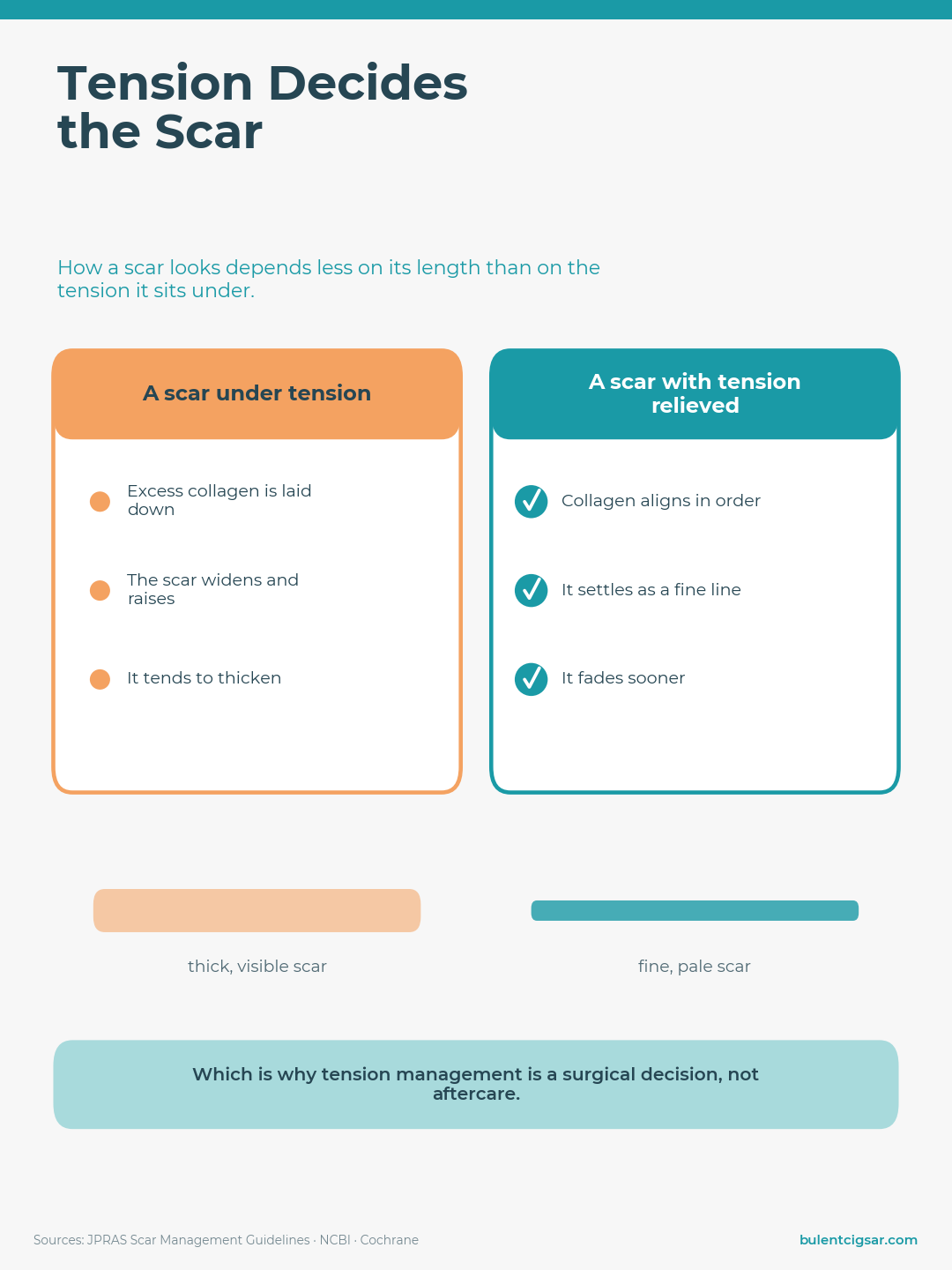
What determines how a scar looks is less about how long it is and more about how much tension it sits under. A scar under constant pull tends to widen, thicken and raise. A scar with tension taken off it tends to settle as a fine line.
The mechanism is the collagen itself: fibres align along lines of stress, and tissue that is continually pulled responds by laying down more collagen. More collagen means a thicker, more visible scar.
Which means tension management isn’t an aftercare detail. It’s a surgical decision — and it’s made on the operating table.
In breast lift surgery this has a concrete expression. Dr. Çığşar favours the vertical technique in suitable cases, and the reason isn’t only that the scar is shorter. It’s about where the tension accumulates.
The traditional inverted-T (anchor) approach adds a long horizontal incision along the fold beneath the breast, and its vertical limbs diverge as they descend. That geometry means tension increases toward the base of the breast — precisely where you want the least tension in order to produce a soft, naturally full lower pole. The T-junction, where three incision lines meet, is also the point where healing is under the most strain.
The vertical technique removes that horizontal incision. The result is both a lower total scar burden and a tension distribution that doesn’t fight the breast’s natural fullness. One decision improves the scar and the shape at the same time.
It isn’t right for everyone. Significant ptosis or a large excess of skin may call for a more extensive approach. The correct technique is matched to the individual’s tissue during consultation — but where the choice exists, the tension argument is a strong one.
Not every scar heals the same way
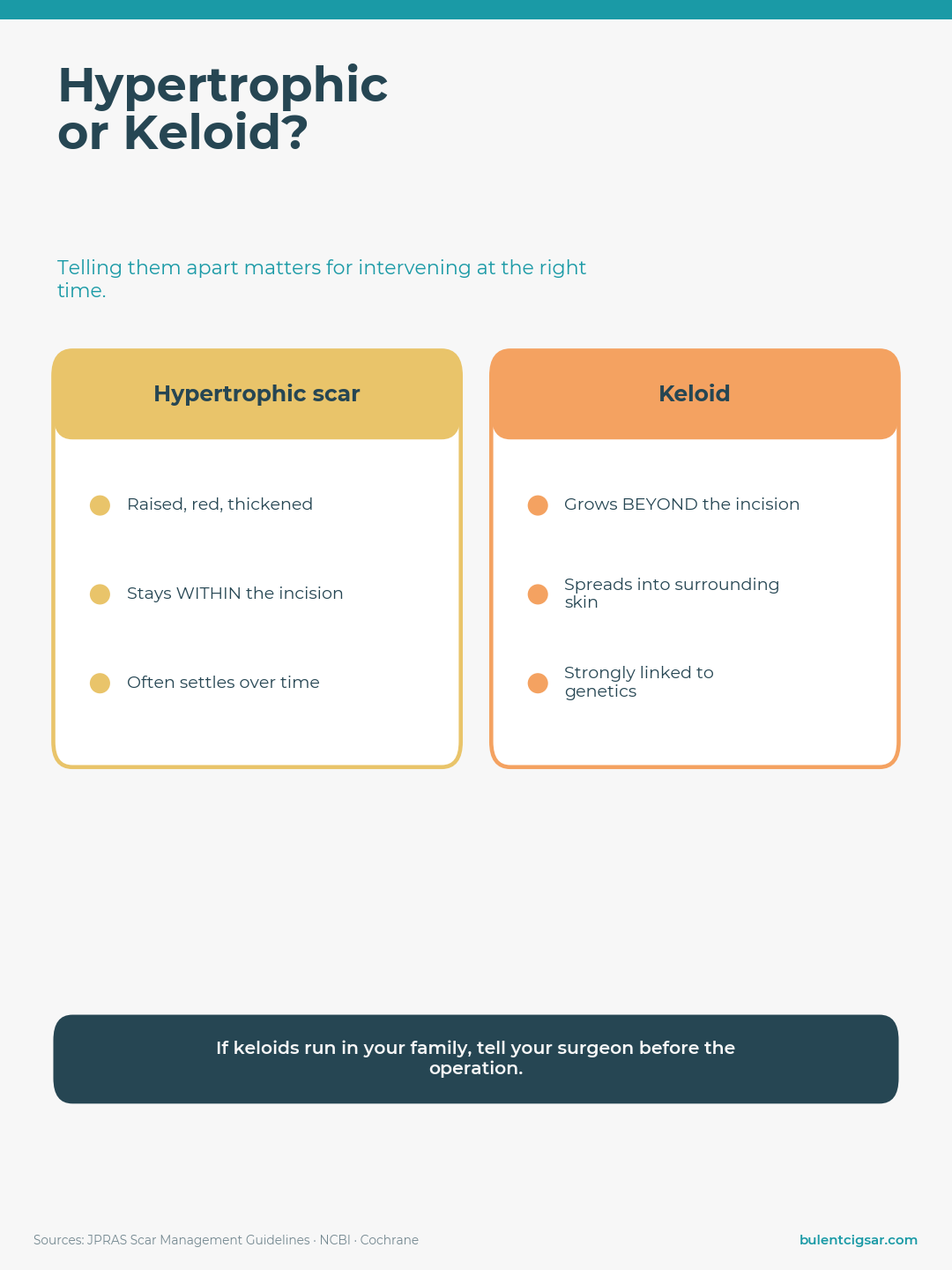
Some scars behave differently, and two patterns are worth telling apart.
Hypertrophic scars are raised, red and thickened, but they stay within the boundaries of the original incision. They come from an overproduction of collagen and often settle down on their own over time.
Keloids extend beyond the original incision into surrounding skin. They’re more stubborn, harder to treat, more common in darker skin types, and strongly influenced by genetics.
Why the distinction matters practically: if keloids run in your family, or if a previous cut of any kind healed raised and thickened, your surgeon needs to know before the operation. That information can change both the technique chosen and the aftercare plan.
If a scar becomes redder again months later, thickens, or starts itching intensely, it should be assessed early. In this area, early intervention works considerably better than late intervention.
What’s actually in your hands
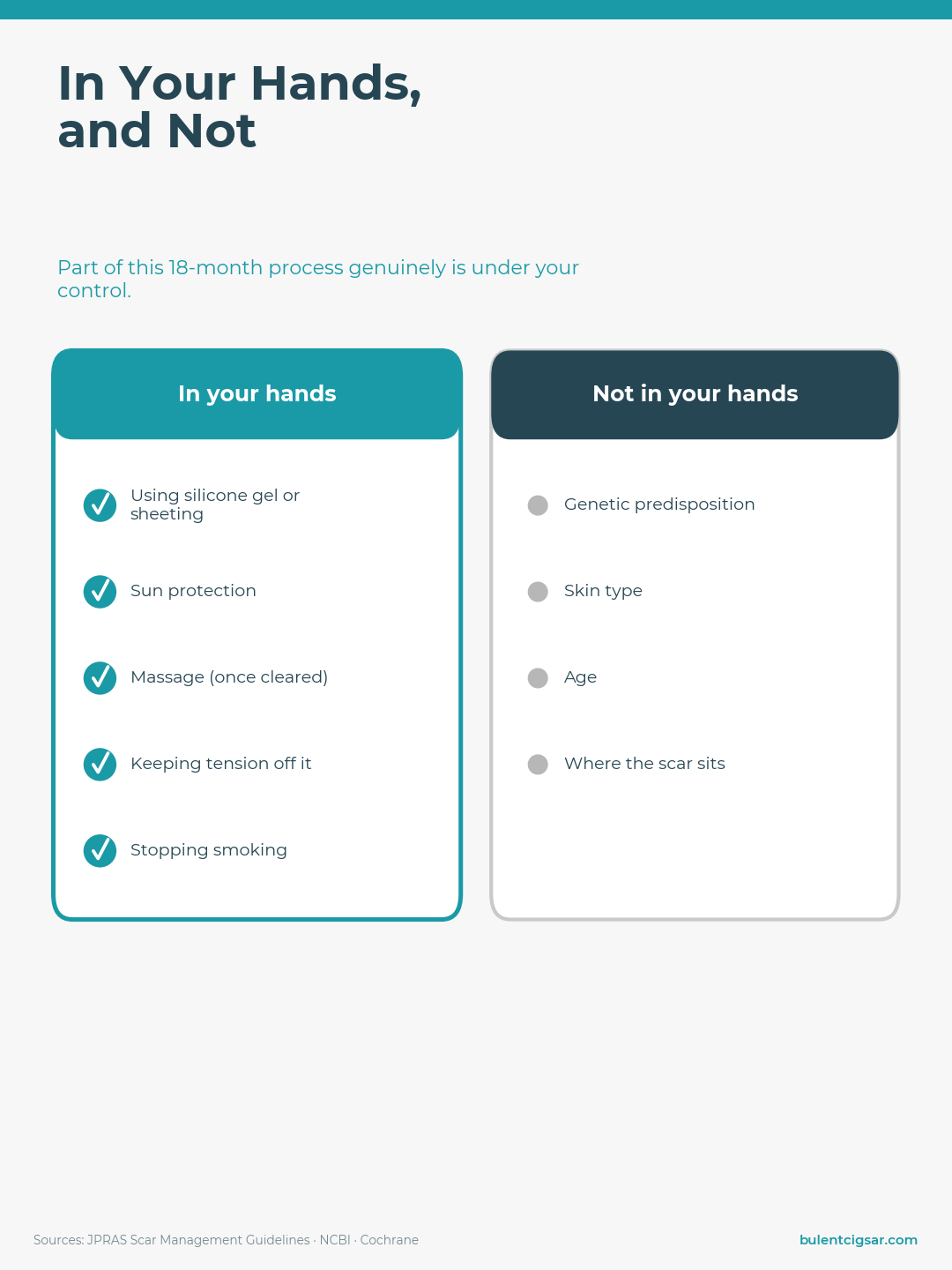
The good news is that part of this 18-month process genuinely is under your control. Here’s what the evidence supports.
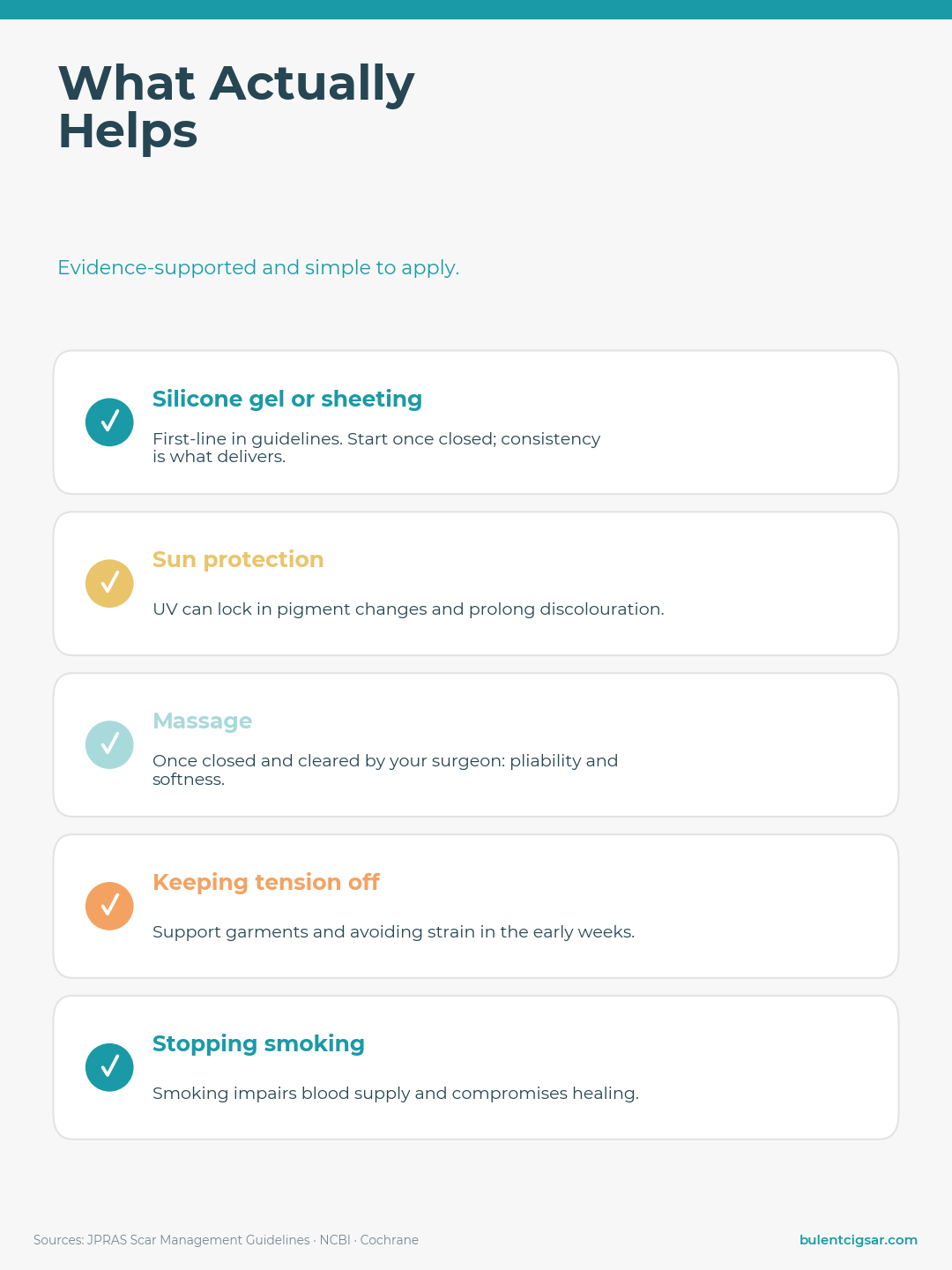
Silicone gel or silicone sheeting. International scar management guidelines recommend silicone as the first-line option for both preventing and treating hypertrophic scars — it’s the one non-invasive measure with enough supporting data to justify an evidence-based recommendation. It’s worth noting that Cochrane reviewers have flagged the quality of many underlying studies as weak, so this is a well-supported convention rather than a settled certainty. The proposed mechanism is occlusion and hydration, which helps regulate excess collagen. Start only once the incision is fully closed, and use it consistently — intermittent use doesn’t deliver.
Sun protection. Fresh scar tissue is vulnerable to ultraviolet light, which can lock in pigment changes and prolong discolouration for months. Covering the area or using high-factor protection is the simplest item on this list and the most commonly skipped.
Massage. Once the incision has fully closed and your surgeon has cleared it, gentle massage helps with pliability and softness.
Keeping tension off it. Avoiding movements that strain the area in the early weeks, and wearing the recommended support garment, reduces the pull on a healing scar. Silicone taping can help offload tension too.
Stopping smoking. Smoking impairs blood supply to healing tissue and directly compromises scar quality. Stopping before and after surgery is one of the strongest levers a patient has.
Some things are not in your control: genetic predisposition, skin type, age, and where on the body the scar sits. High-tension areas like the shoulders and the front of the chest are simply harder territory.
How we approach it
Because a scar is a process that begins in surgery and continues for months, we don’t treat it as something that ends when the operation does.
At the planning stage we ask about skin type, previous scar history and any family history of keloids. That information influences the technique. Incisions are planned so the scar sits where clothing and underwear will cover it, and so tension is distributed away from the lines that shape the result.
In suitable cases Dr. Çığşar uses the vertical technique — both because it lowers the total scar burden and because it keeps tension from accumulating at the lower pole of the breast. During closure, particular attention goes to closing tissue in layers and without tension, since deep tension is one of the most common reasons a surface scar thickens.
After surgery, patients aren’t left to interpret their own healing. We explain what they’ll see and when, which stage is normal, and how to run the aftercare plan. Because what a patient watching their scar usually needs most isn’t a product — it’s an accurate timeline.
The takeaway
A surgical scar is the visible record of how the body repairs itself. Even when it’s red, that colour is a sign of work in progress, not of something going wrong.
Where the incision goes is decided in the operating room. How that line eventually looks is decided over the following months — by the body’s own remodelling, and by a handful of simple measures taken along the way.
Which is why the most accurate thing anyone can tell you is this: your scar isn’t decided in the operating room. It’s decided over the next 18 months — and part of that is in your hands.
Dr. Bülent Çığşar has been practicing plastic, reconstructive, and aesthetic surgery in Istanbul for over 25 years. Please contact us with any questions you may have about aesthetic procedures or schedule an online consultation.
FAQ
How long does it take for a surgical scar to fade?
Full maturation takes 12 to 24 months. The first three months are when the scar looks most prominent; the real improvement happens over the months that follow.
My scar is red and raised — is that normal?
In the early months, yes. Collagen production and new blood vessel formation peak during this phase, which is what produces the redness. As the vessels regress, the colour lightens. But if a scar becomes redder again months later, thickens, or itches intensely, have it assessed.
Why doesn’t a scar disappear completely?
Because the body repairs skin rather than restoring it. A mature scar is dense collagen tissue without hair follicles or sweat glands, so it fades, flattens and softens — but it never becomes identical to surrounding skin.
What scar treatments actually work?
Guidelines recommend silicone gel or sheeting as first-line, alongside sun protection, gentle massage once the incision has closed, keeping tension off the area, and not smoking. Consistency matters more than which product you choose.
What’s the difference between a hypertrophic scar and a keloid?
A hypertrophic scar is raised but stays within the original incision boundaries and often settles over time. A keloid grows beyond those boundaries into surrounding skin, is more stubborn, and is strongly linked to genetic predisposition.
How much does the surgeon influence the scar?
Considerably. Where the incision is placed, how tension is distributed, and how the tissue is closed are all surgical decisions. Tension management in particular is one of the strongest determinants of how a scar looks long-term.
References
Updated Scar Management Practical Guidelines — Journal of Plastic, Reconstructive & Aesthetic Surgery.
Silicone Gel for Scar Prevention — Textbook on Scar Management, NCBI.
Silicone gel sheeting for preventing and treating hypertrophic and keloid scars — Cochrane review.
Vertical Mastopexy — tension distribution and the lower pole.
Mastopexy: Periareolar, Vertical, and Wise Pattern — technique indications.