
You Lost the Weight. Now What About the Skin?
Over the past two years, a new kind of patient has been walking into plastic surgery clinics. Someone who did the hard part — who lost the weight, hit the goal, changed their health — and then looked in the mirror and found something they weren’t expecting.
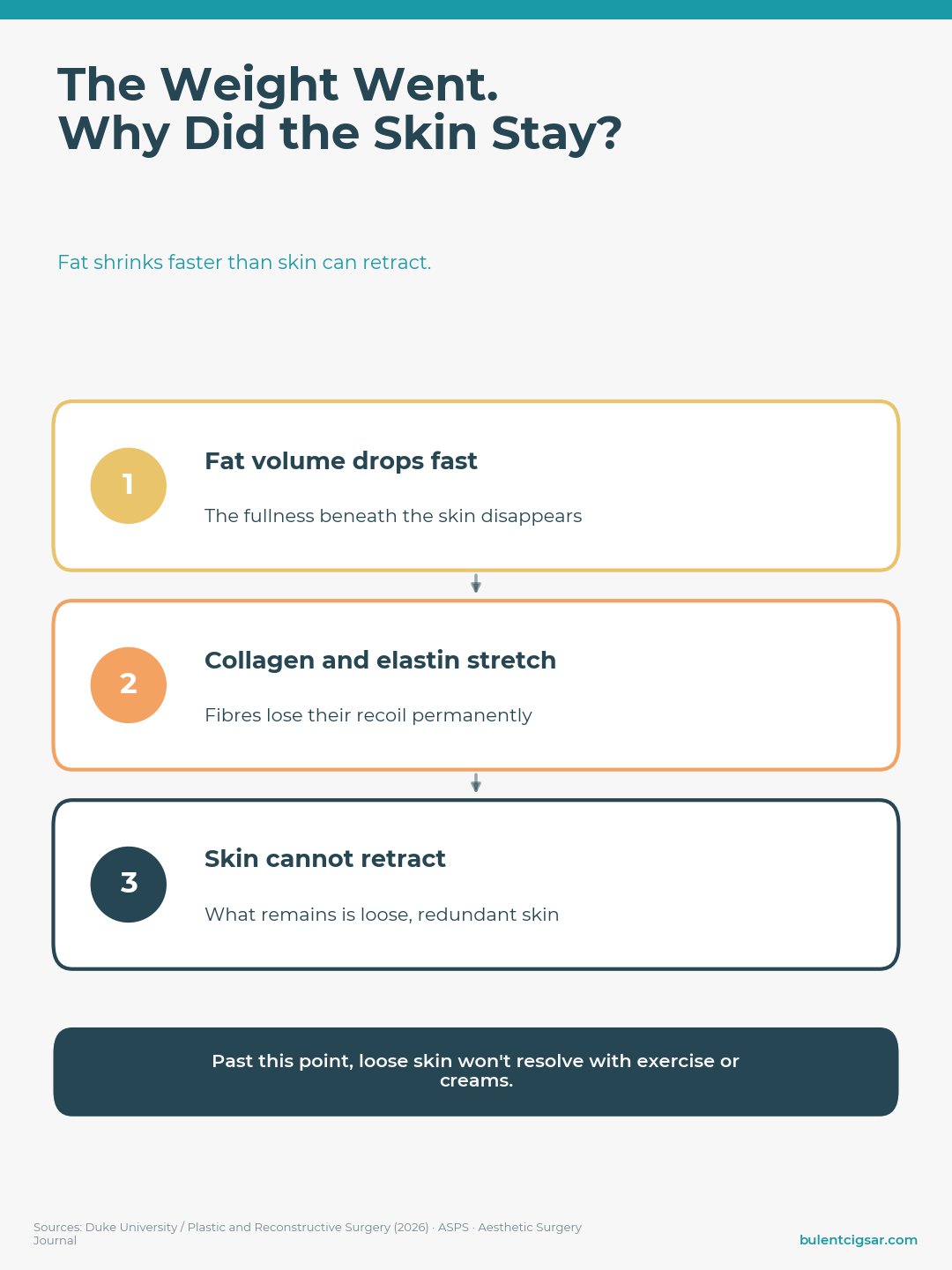
The reason is simple, if unfair: fat tissue shrinks faster than skin can retract. When the loss is large and rapid, what’s left behind is skin that has lost its underlying volume and won’t spring back. The number on the scale reflects the achievement. The silhouette doesn’t.
This isn’t a discipline problem, and it isn’t something the gym can fix. Skin doesn’t behave like fabric. Past a certain point, the collagen and elastin that give it recoil are permanently stretched.
And this picture has become far more common very recently — because the way people lose weight has changed.
A new population, almost overnight
GLP-1 medications — semaglutide (Ozempic, Wegovy) and tirzepatide (Mounjaro, Zepbound) — have produced weight loss at a scale the field has never seen, with many patients losing 15–25% of their body weight.
The numbers behind the shift are striking. The American Society of Plastic Surgeons measured weight-loss medication use for the first time in its 2024 report, finding that more than 800,000 aesthetic patients had used GLP-1 medications. Of those, 20% had already undergone plastic surgery, 39% were considering a surgical procedure, and 41% were exploring non-surgical options.
So there’s a large and growing question in the room: what happens after the weight comes off?
There’s also an answer that most of the internet isn’t giving — because it runs against the marketing.
The new research: speed is not an advantage
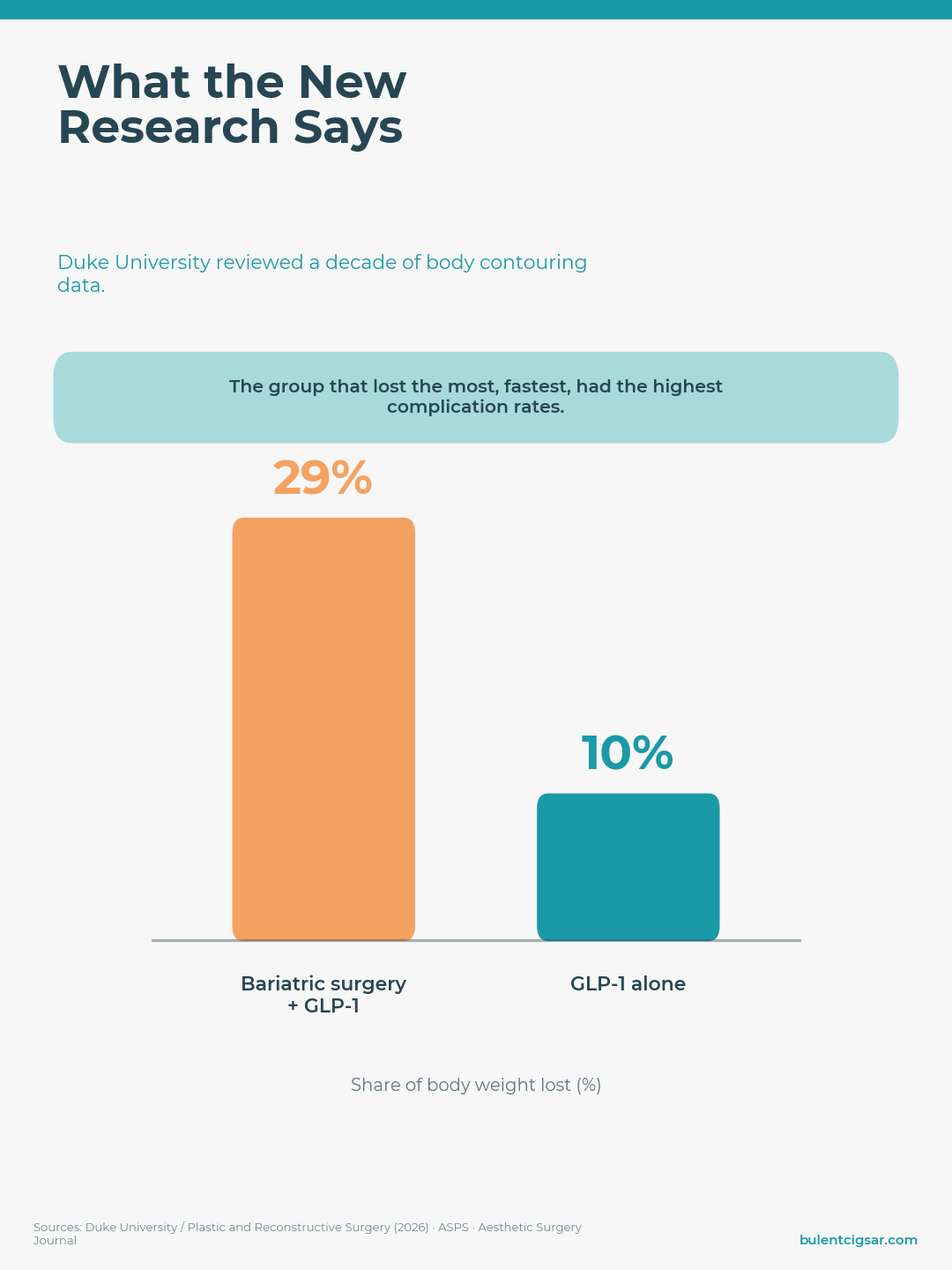
A Duke University study published in Plastic and Reconstructive Surgery in 2026 examined more than a decade of abdominal body contouring procedures. The finding was clear: patients who lost large amounts of weight quickly faced higher rates of surgical complications.
The highest complication rates appeared in patients who combined bariatric surgery with GLP-1 therapy. That group lost roughly 29% of their body weight, compared with about 10% among those using the medication alone — and they lost it fastest.
The proposed explanation makes intuitive sense. Patients who lose weight more slowly, through sustained changes, tend to have fewer problems, because their body and their skin have had time to adapt. Rapid loss leaves the body less prepared for a major operation.
One clarification matters here, because this finding is easy to misread. It is not an argument against losing weight. As the study’s senior author put it, the point isn’t to discourage weight loss — it’s to optimise outcomes. The question isn’t whether. It’s when.
Why speed creates a problem
Several mechanisms are working at once.
Skin can’t keep up. Skin has some capacity to retract when the volume beneath it decreases gradually. Rapid loss removes that window. Once collagen and elastin fibres have been stretched past their limit, they don’t recover.
Muscle mass goes too. GLP-1 medications work substantially by suppressing appetite. When caloric intake falls sharply, what’s lost isn’t only fat — lean body mass and overall nutritional status can decline as well. That is directly relevant to how a wound heals.
Nutrition determines healing. Protein and micronutrient deficits impair wound healing and raise infection risk. Body contouring involves long incisions and a substantial healing demand, so this isn’t a marginal concern.
There’s a related misconception worth naming. These operations are often perceived as minor or purely cosmetic. In practice, a tummy tuck, an arm lift or a thigh lift is a major operation with long incisions and a real recovery.
What “stable weight” actually means
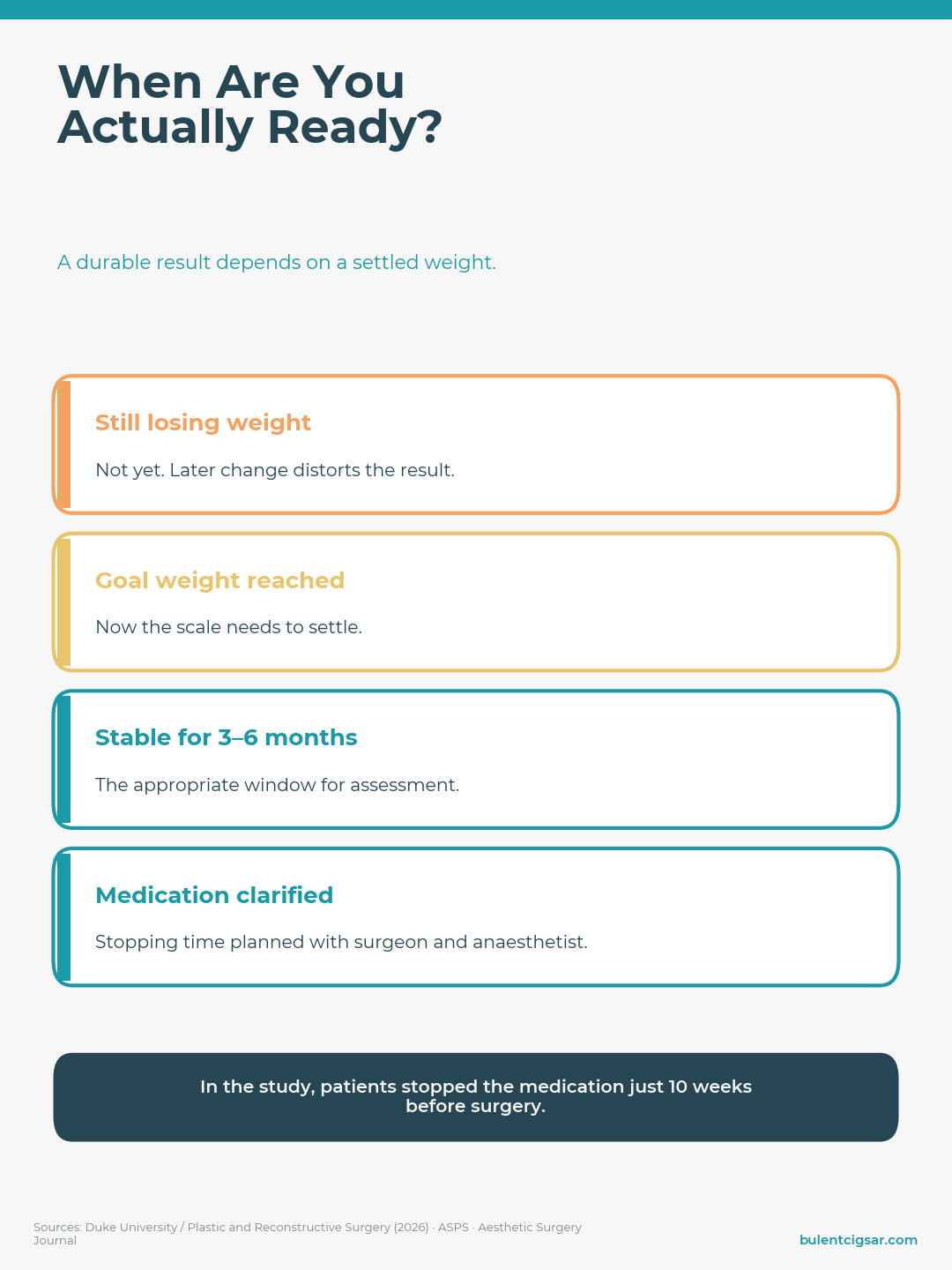
The prevailing surgical guidance is that weight should be stable for at least three to six months before body contouring.
The logic is straightforward. The operation is planned around the body you have on the day. Lose more weight afterwards and skin can loosen again. Regain weight and the result can be distorted. Stability is the precondition for a durable outcome.
One detail from the Duke data shows how compressed the timelines have become in practice: GLP-1 patients had been on the medication for an average of 103 weeks and stopped it just 10 weeks before surgery. Patients who had bariatric surgery, by contrast, typically waited about two years before seeking body contouring.
One group waits for the process to finish. The other arrives while it’s still running.
The anaesthesia conversation you need to have
There’s a safety point here that deserves to be stated plainly.
GLP-1 medications work partly by slowing gastric emptying — that’s the same mechanism that produces prolonged fullness. Under general anaesthesia, however, that can become a risk: the stomach may not be as empty as assumed, raising the possibility of stomach contents entering the airway.
This is why the timing of stopping the medication before surgery should be planned jointly by the surgeon and the anaesthetist. The patient’s job is simple but essential: disclose any weight-loss medication you are taking or have recently taken — including the dose, how long you were on it, and when you last used it.
One further note: whether the medication was an approved, prescribed product or a compounded preparation of uncertain content also matters, because inconsistent dosing history complicates perioperative planning.
Where the skin shows
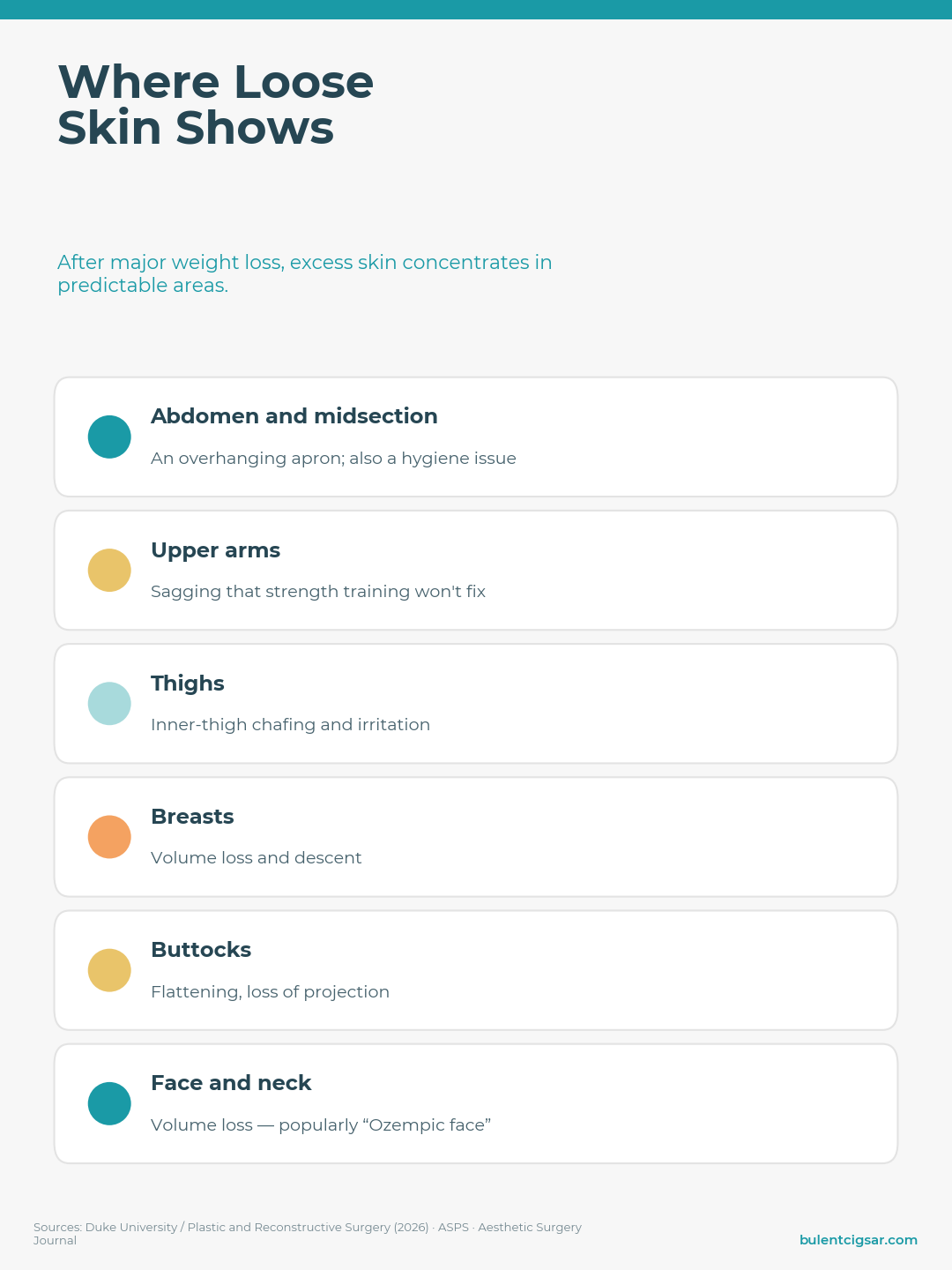
After major weight loss, excess skin tends to concentrate in predictable areas:
- Abdomen and midsection. The most common complaint. Loose skin can form an overhanging apron, which becomes a hygiene and skin-irritation issue as much as an aesthetic one.
- Upper arms. Sagging along the inner upper arm that doesn’t respond to strength training.
- Thighs. Excess inner-thigh skin causing chafing and irritation.
- Breasts. Volume loss and descent. Breast tissue is substantially fat, so it’s directly affected by weight loss.
- Buttocks. Flattening and loss of projection.
- Face and neck. Hollowed cheeks, jowling, a tired appearance. What’s popularly called “Ozempic face” is simply rapid fat loss showing up in the face.
That last one points to something important: not every problem is solved by removing skin. In some areas the deficit isn’t excess skin — it’s lost volume. There, the answer isn’t tightening. It’s restoring volume, often using the patient’s own fat.

How we approach it
The emotion we encounter most often in this group is impatience — and it’s entirely understandable. Someone has completed something difficult and wants to see the result.
We don’t encourage rushing. In consultation we look at how quickly the weight came off, whether the scale has been stable for the past three to six months, whether the loss is still ongoing, and whether the goal weight has actually been reached. Current or recent medications, nutritional status and any protein deficit are part of that same assessment.
When Dr. Çığşar plans these cases, he thinks in terms of sequence rather than a single operation. For some patients the abdomen comes first; for others the breasts and trunk are addressed together. Doing everything at once isn’t always right — surgical burden and healing capacity are part of the calculation.
Where the issue is lost volume rather than excess skin, fat transfer comes into play: fat taken from one area is used to restore fullness in another. Dr. Çığşar has been performing fat transfer since 2008, and that experience is particularly useful in post-weight-loss volume restoration.
And we set expectations honestly. These operations leave scars. Incision length is dictated by how much skin needs to come out, and incisions are positioned to sit under clothing. What the scar buys is a contour free of redundant skin. That trade cannot be decided well unless it’s discussed openly first.

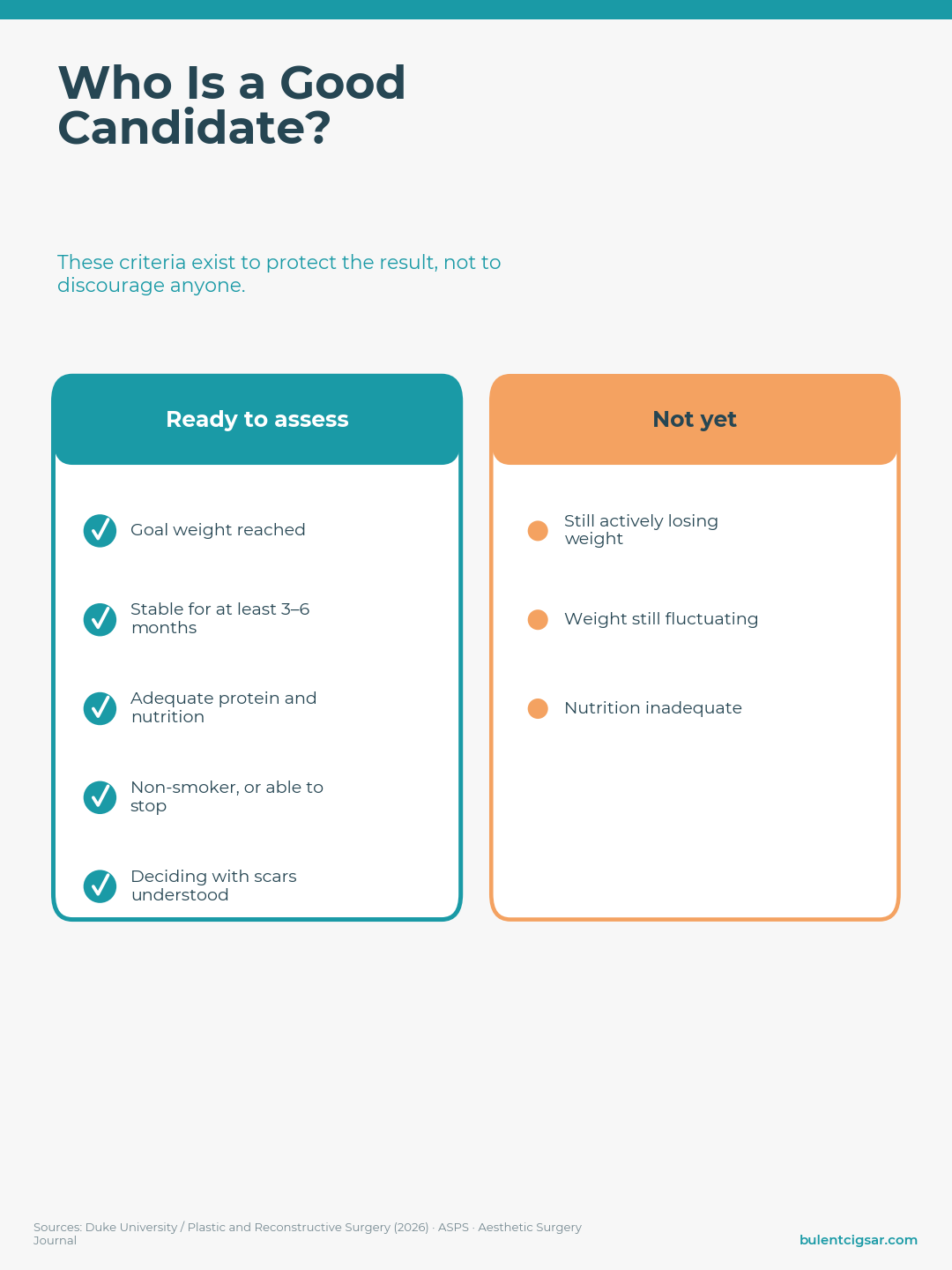
Who is a good candidate?
- Someone who has reached their goal weight and has been stable for at least three to six months
- Someone eating well, with adequate protein intake
- A non-smoker, or someone able to stop before surgery
- Someone in good general health for a major operation
- Someone deciding with a clear understanding that these procedures leave scars
- For anyone still actively losing weight, the answer is straightforward: not yet
None of these criteria exist to discourage anyone. They exist because the result depends on them.
Istanbul, and the international patient
Turkey is one of the world’s leading destinations for both bariatric and aesthetic surgery, which is why a large share of post-weight-loss body contouring patients travel here.
For an international patient, timing matters even more. If you’re planning a significant trip, your weight needs to be settled and your medication history clarified in advance. Part of that assessment can be done in an online consultation — so you find out whether this is the right moment before you book anything.
Take the Next Step at the Right Time
Losing weight is demanding, and everyone who completes that journey deserves to see the result. But body contouring is the final step of that journey — not a step taken in the middle of it.
What the newest research confirms is precisely this: the outcome depends not only on how much weight you lost, but on how quickly you lost it and at what point surgery is planned. Waiting for the right moment doesn’t mean giving up the result. It protects it.
Would you like a personalised assessment and an expert opinion on the changes in your body after weight loss?
Take the first step — book your free consultation today!
To make sure your effort pays off at the right time and in the safest way, get in touch with us!
🌍 International patients welcome — DM or WhatsApp for an online consultation.
📞 +90 552 452 49 09
FAQ
Will loose skin tighten on its own after weight loss?
Partly, but only up to a point. When the loss is large and rapid, collagen and elastin fibres lose their recoil permanently. At that stage, excess skin won’t resolve with exercise or topical products.
I’ve been using a GLP-1 medication — when can I have surgery?
The general guidance is to wait until your weight has been stable for at least three to six months. When to stop the medication before surgery should be planned jointly by your surgeon and anaesthetist. Always disclose the medication, the dose and when you last took it.
Does losing weight quickly make surgery riskier?
A recent Duke University study found that large, rapid preoperative weight loss was associated with higher complication rates, with the highest rates among patients who combined bariatric surgery with GLP-1 therapy. This isn’t an argument against weight loss — it’s an argument for correct timing.
What is “Ozempic face” and can it be treated?
It’s the popular name for facial volume loss following rapid weight loss, producing hollowed cheeks and a tired appearance. Because the deficit is volume rather than excess skin, the usual answer isn’t tightening — it’s restoring volume, often through transfer of the patient’s own fat.
Do these procedures leave scars?
Yes. Removing excess skin requires incisions, and their length depends on how much skin must come out. Incisions are planned to sit under clothing. This trade-off should be discussed openly before any decision.
Can everything be done in one operation?
Not always. Surgical burden, healing capacity and safety often mean procedures are staged. The sequence is planned around the individual.
References
- Duke University School of Medicine — In the Age of GLP-1s, Plastic Surgeons Face a New Reality (2026); study published in Plastic and Reconstructive Surgery.
- Duke Today — How Weight Loss Drugs Pose Challenges for Plastic Surgeons.
- Postoperative Outcomes in Body Contouring Procedures Following GLP-1 Receptor Agonist Use: A 10-Year Analysis — Aesthetic Surgery Journal.
- Safety of GLP-1 receptor agonists in body contouring surgery: a systematic review and meta-analysis — BMC Plastic and Reconstructive Surgery (2026).
- Weight loss drugs pose challenges for plastic surgeons — Bariatric News.
- ASPS 2024 Procedural Statistics Report — press release — American Society of Plastic Surgeons
- 2024 Plastic Surgery Statistics Report (PDF) — American Society of Plastic Surgeons