Implants, Fat Transfer, Reduction: What Breast Surgery Means for Your Mammogram
Every October, the message is the same, and it's the right one: find it early. According to the World Health Organization, an estimated 2.4 million women were diagnosed with breast cancer in 2024 — and early detection and treatment are what bring the death toll down.
But there's a question that rarely makes it into the awareness campaigns, even though it applies to an enormous number of women: what if you've had breast surgery?
In the United States alone, ASPS member surgeons performed more than 306,000 breast augmentations and nearly 77,000 cosmetic breast reductions in 2024. Every one of those women will, at some point, stand in front of a mammography machine.
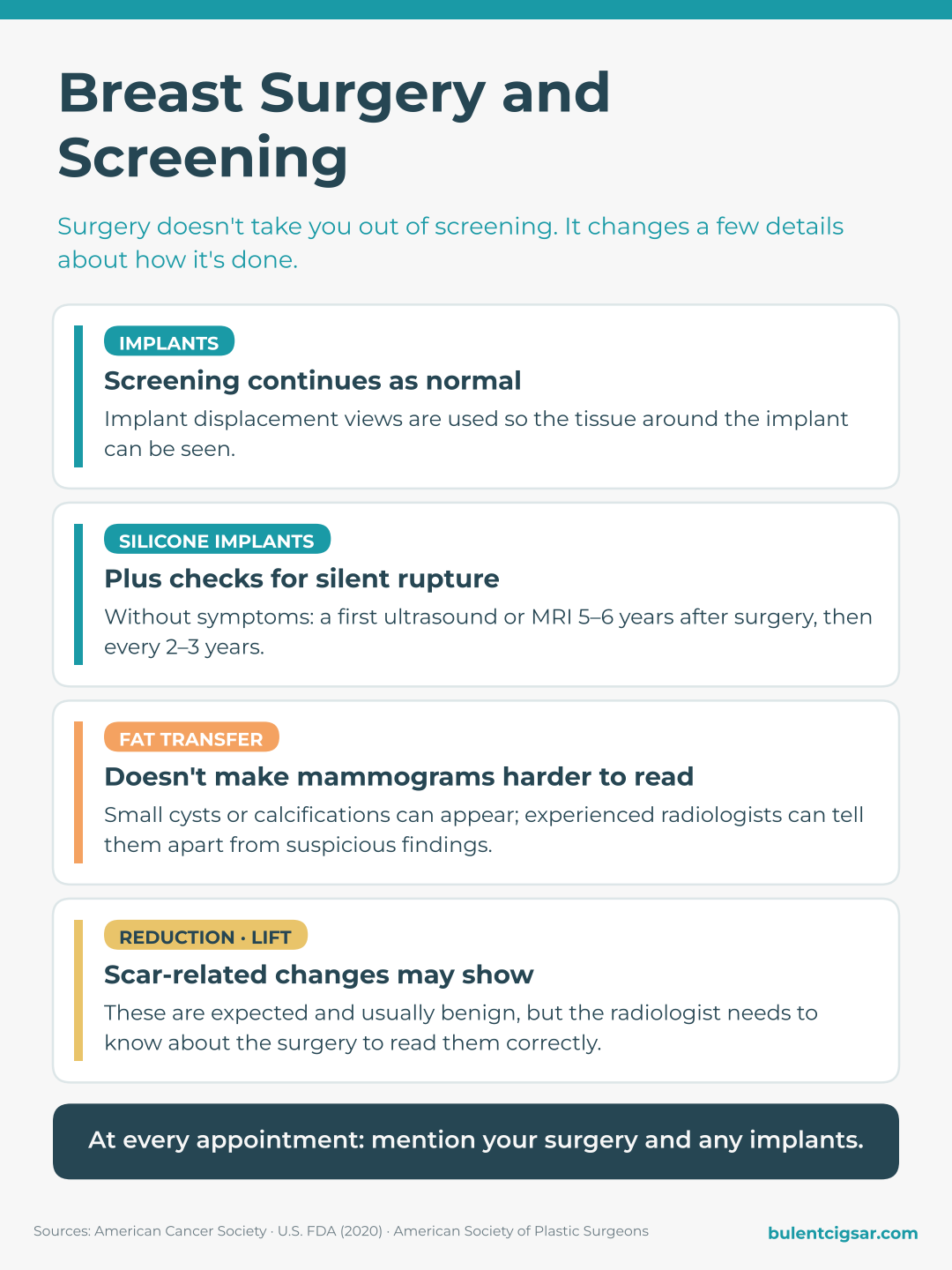
Here's the reassuring part, up front: breast surgery does not take you out of screening. It changes a few details about how screening is done — and those details are worth knowing.
Before surgery: start with a clean baseline
The first step happens before the operation. You want to know the state of your breasts before anything changes them — both so nothing is missed, and so future images have a reference point.
A commentary in the Medical Journal of Australia made the case with a sobering example: a 46-year-old woman who had breast augmentation without any preoperative imaging was diagnosed with breast cancer just six months later — what the authors called a probable missed opportunity for earlier diagnosis. Their conclusion was direct: except in rare circumstances, preoperative breast imaging should be considered essential, tailored to age, risk and breast density — usually mammography, sometimes with ultrasound, occasionally MRI.
If your age or risk profile already puts you in a screening programme, the simplest move is to make sure your most recent screen is up to date before surgery is scheduled.
Mammograms with implants: yes — with the right technique
This is the question we hear most. The answer from the American Cancer Society is unambiguous: if you have breast implants, you should still get regular screening mammograms.
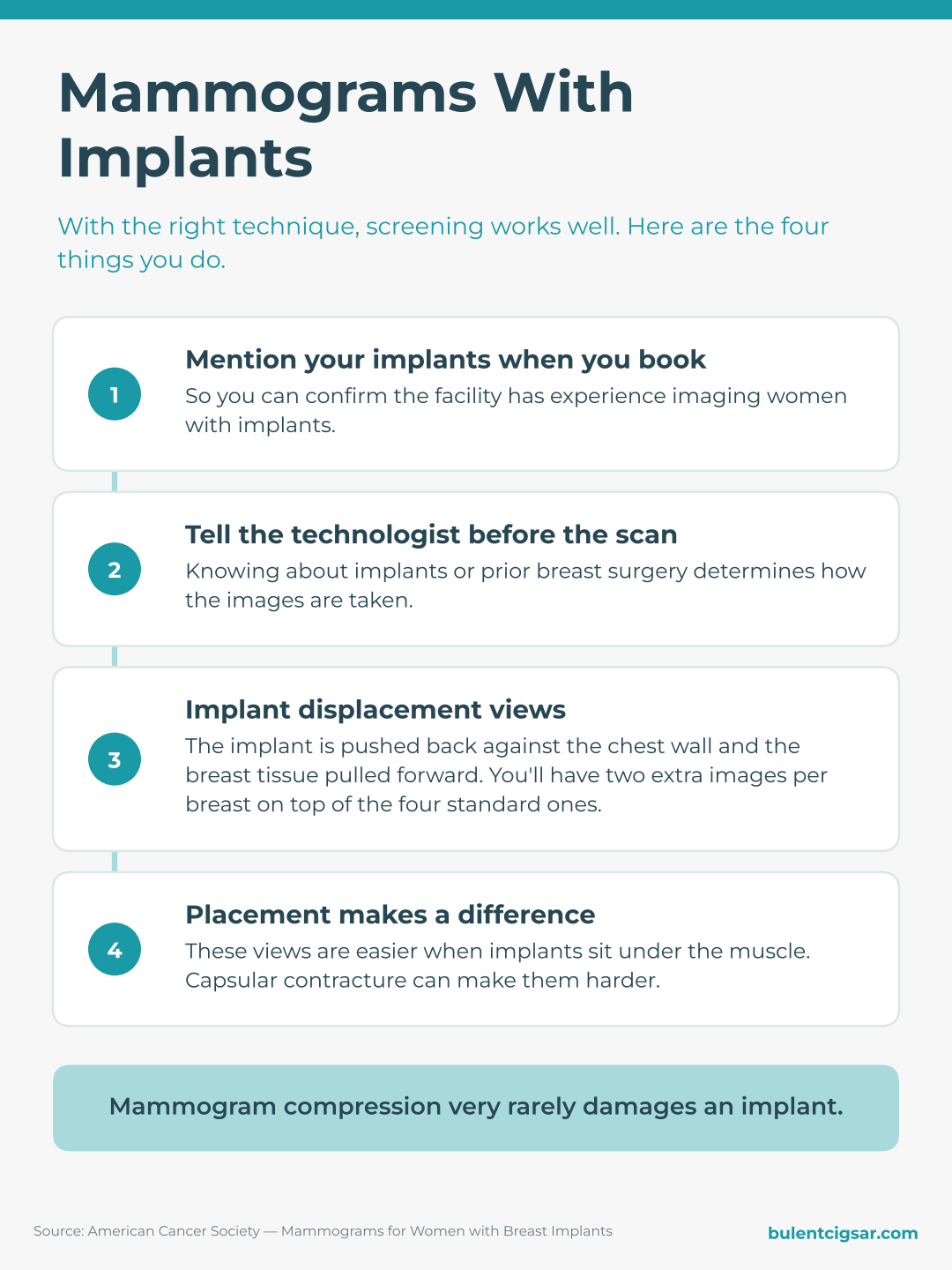
What changes is the technique. Silicone and saline implants block X-rays, which means the breast tissue immediately around the implant can be hidden on a standard image. Radiographers solve this with implant displacement views: the implant is gently pushed back against the chest wall while the breast tissue is pulled forward and compressed on its own. You'll typically have two extra images of each breast in addition to the four standard ones.
A few practical points from the ACS make a real difference:
- Mention your implants when you book. It lets you confirm the facility has experience imaging women with implants.
- Tell the technologist before the scan. Knowing about implants or prior breast surgery determines how the images are taken.
- Placement matters. Displacement views are easier when implants sit beneath the chest muscle. Firm scar tissue around the implant (capsular contracture) can make them harder and less comfortable.
- Damage is very rare. Compression very rarely ruptures an implant — one more reason to flag it in advance.
Why do these details matter so much? A BMJ systematic review and meta-analysis of observational studies found that women with cosmetic implants were more likely to be diagnosed at a later stage. The authors were careful to say the findings should be interpreted with caution, since some included studies didn't adjust for other factors. But the practical lesson is clear: implants don't cause the cancer — the point is to make sure the screening around them is done properly.

Silicone implants: a second kind of check
Mammography screens for cancer. If you have silicone implants, there's a separate question: is the implant itself intact? Silicone implants can rupture "silently", without any symptoms.
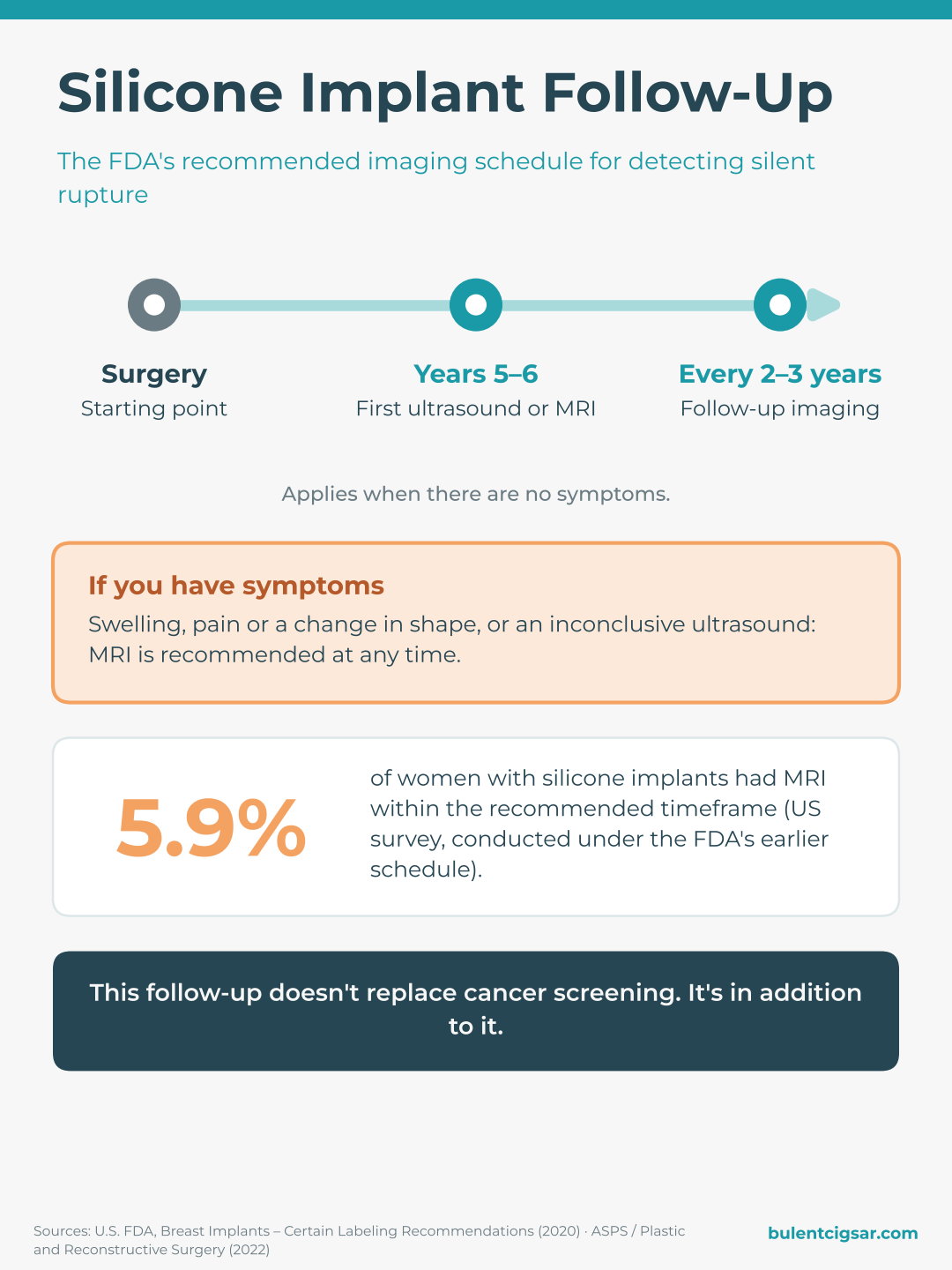
The FDA's 2020 labelling guidance sets out a clear schedule: for women without symptoms, the first ultrasound or MRI should be performed at 5–6 years after surgery, then every 2–3 years thereafter. If you have symptoms, or an ultrasound is inconclusive, an MRI is recommended at any time. The FDA notes that MRI is the most effective method for detecting silent rupture, with ultrasound an acceptable alternative for screening women without symptoms.
In practice, this is the follow-up most often forgotten. In a survey published in Plastic and Reconstructive Surgery, only 5.9% of women with silicone implants had MRI screening within the recommended timeframe. That study predates the FDA's current, less intensive schedule — but the lesson stands: if the plan isn't set out at the start, it tends not to happen.
Does fat transfer confuse the radiologist?
Fat transfer to the breast uses your own fat, harvested by liposuction, purified and re-injected. When the technique became popular, the worry was that it might muddy mammograms — because a small portion of transferred fat can form oil cysts or calcifications as it heals.
The ASPS's original position was that concern about fat grafts interfering with cancer detection was not validated by the studies available — while calling for caution in women at high risk of breast cancer.
Researchers at the Léon Bérard Cancer Center in Lyon then looked directly at the images. Comparing mammograms before and after fat transfer, they found no significant differences, no change in breast density, and no increase in suspicious findings. Some women had small calcifications or cysts, but none were considered likely to suggest cancer. Their conclusion: radiographic follow-up of breasts treated with fat grafting is not problematic.
Your part, as with implants, is simple: tell the radiologist. Knowing about previous fat transfer makes it far easier to read benign changes correctly.
After reduction or a lift
Breast reduction and breast lift reshape the tissue, so later mammograms can show scar-related changes. These are expected and usually benign — but again, the radiologist needs to know about the surgery to interpret them correctly.
Reduction has one more screening dimension that's easy to overlook: the removed tissue is commonly sent for pathology. In a Sheffield series of 1,588 women, this examination found a previously unsuspected cancer in 0.31%. The rate is low — but for those few women, the operation became an unexpected opportunity for early diagnosis.
The question underneath it all: does any of this raise my risk?
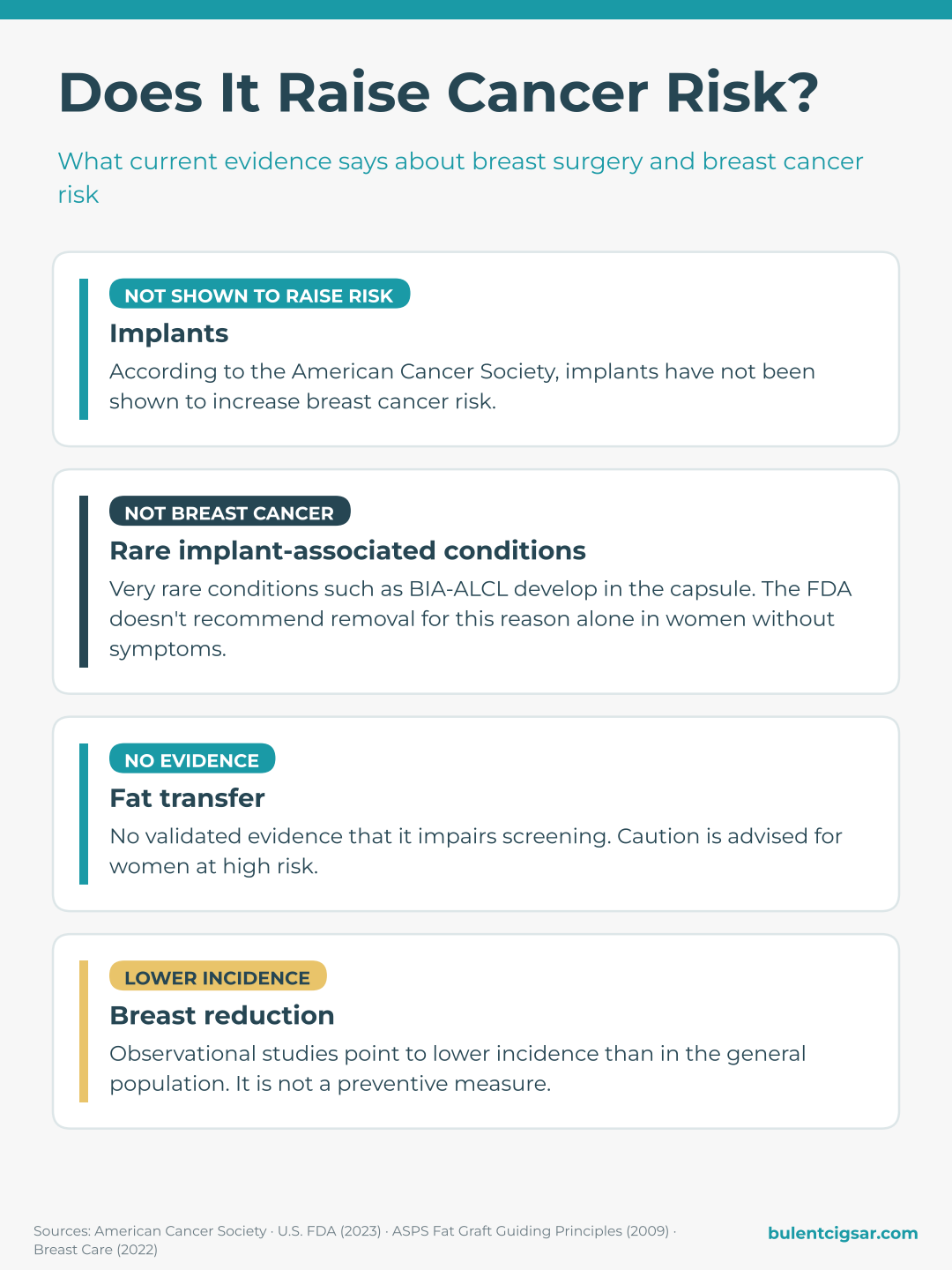
The evidence here is largely reassuring.
- Implants. According to the American Cancer Society, breast implants have not been shown to increase the risk of breast cancer, nor have women with implants been shown to have more recurrence.
- Rare implant-associated conditions. Honesty requires a distinction. A few very rare conditions are linked to implants — and they are not breast cancer. The best known is BIA-ALCL, a lymphoma that can develop in the capsule around an implant. The FDA has also reported rare cases of squamous cell carcinoma in the capsule, while stating clearly that it does not recommend removing implants solely because of this concern in women without symptoms. New swelling, pain or a change in shape should always be reported.
- Fat transfer. Current studies haven't shown that it impairs screening or raises risk — with the ASPS advising caution in women with a personal or family history of breast cancer.
- Reduction. Observational research, including an Austrian cohort study that also reviewed earlier evidence, points to a lower breast cancer incidence after reduction than in the general population. It is not a preventive measure, though — screening continues afterwards.
How we approach it
We treat breast aesthetics as part of women's health, not separate from it — so every consultation starts with the full picture.
Dr. Bülent Çığşar reviews family history, any previous imaging, and whether age-appropriate screening is up to date. Where it's needed, surgery is planned once current imaging is in hand. That isn't a delay; it's putting the result on solid ground.
The operation itself is planned with the long term in mind, including how the breasts will be followed up afterwards. Dr. Çığşar has been performing fat transfer since 2008, and in women at higher risk its suitability is assessed separately and carefully. For lifts and reductions, his preferred vertical technique offers a reduced-scar approach.
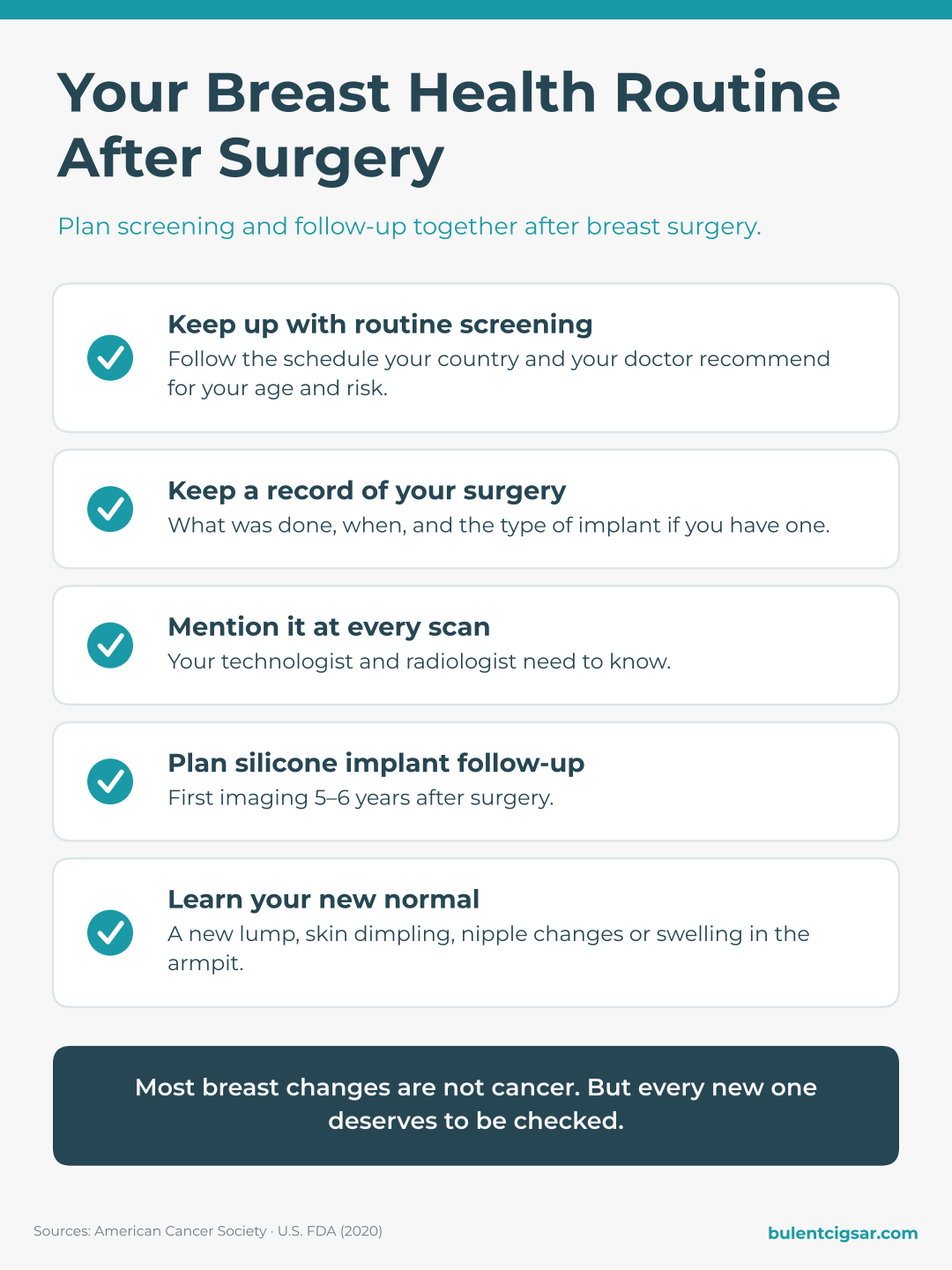
After surgery, we recommend keeping a record of what was done — and, if you have implants, their type — to share at every mammogram. For silicone implants, follow-up imaging is part of the post-operative plan from day one.
Learn your new normal
After breast surgery, your breasts look and feel different. Getting to know that new normal once you've healed is what allows you to spot changes later — a new lump, skin dimpling, nipple changes, swelling in the armpit.
Most breast changes are not cancer. But every new one deserves to be checked.
Travelling to Istanbul for surgery
For international patients, screening needs a little more planning. Sharing recent imaging before you travel lets us settle the surgical plan during the online consultation. And before you fly home, you'll have everything you need to continue screening and follow-up with your own doctors.
Beauty and Health, Side by Side
Breast aesthetics and breast health aren't competing priorities. With the right planning, the right technique and the right follow-up, both are protected in the same journey. This October, it's worth reminding yourself — and the women you love — that screening still matters, whatever surgery you've had.
Would you like a personalised assessment of your breast health before or after breast surgery?
Take the first step — book your free consultation today!
To make the right decision for both your look and your health, get in touch with us!
🌍 International patients welcome — DM or WhatsApp for an online consultation.
📞 +90 552 452 49 09
FAQ
Can I get a mammogram if I have breast implants?
Yes. The American Cancer Society advises women with implants to continue regular screening mammograms. Mention your implants when booking and before the scan so implant displacement views can be taken.
Can a mammogram rupture my implant?
This is very rare. Telling the technologist about your implants beforehand helps minimise that risk and ensures the right images are taken.
Do I need an MRI if I have silicone implants?
The FDA recommends that women without symptoms have a first ultrasound or MRI 5–6 years after surgery, then every 2–3 years, to check for silent rupture. MRI is recommended at any time if there are symptoms. This doesn't replace cancer screening — it's in addition to it.
Do breast implants cause cancer?
According to the American Cancer Society, breast implants have not been shown to increase breast cancer risk. Rare implant-associated conditions such as BIA-ALCL are not breast cancer, and the FDA does not recommend removing implants solely over this concern in women without symptoms.
Does fat transfer to the breast affect mammograms?
Current evidence shows it doesn't meaningfully impair mammogram interpretation. Small cysts or calcifications can appear; telling the radiologist about the procedure helps them read these correctly.
Does breast reduction lower cancer risk?
Several observational studies point to lower breast cancer incidence after reduction compared with the general population. It isn't a preventive measure, and screening should continue afterwards.
Do I need a mammogram before breast surgery?
That depends on your age, risk and breast density. Up-to-date imaging before surgery helps catch anything that might otherwise be missed and gives a clear baseline for future screening.
References
- World Health Organization — Breast cancer: Fact sheet
- American Society of Plastic Surgeons — 2024 Plastic Surgery Statistics Report (PDF)
- Flitcroft KL, Spillane AJ, Read RL. Lack of appropriate imaging before breast augmentation can have serious patient consequences — Medical Journal of Australia, 2014
- American Cancer Society — Mammograms for Women with Breast Implants
- Lavigne E, et al. Breast cancer detection and survival among women with cosmetic breast implants: systematic review and meta-analysis of observational studies — BMJ, 2013
- U.S. Food and Drug Administration — Breast Implants – Certain Labeling Recommendations to Improve Patient Communication (2020)
- U.S. Food and Drug Administration — Risks and Complications of Breast Implants
- American Society of Plastic Surgeons — Few Patients Undergo Recommended MRI Screening After Silicone Implant Breast Surgery (Plastic and Reconstructive Surgery, 2022)
- American Society of Plastic Surgeons — Fat Transfer/Fat Graft and Fat Injection: ASPS Guiding Principles (PDF) (2009)
- American Society of Plastic Surgeons — Breast Lipomodeling Doesn't Interfere with Mammograms
- Goyal A, et al. Occult breast carcinoma in breast reduction specimens in European women — Breast Cancer Research and Treatment, 2011
- American Cancer Society — Unclear, Disproven, and Controversial Breast Cancer Risk Factors
- U.S. Food and Drug Administration — UPDATE: Reports of Squamous Cell Carcinoma (SCC) in the Capsule Around Breast Implants (2023)
- Niepel A, et al. Influence of Breast Reduction Surgery on Long-Term Breast Cancer Risk in Austria — Breast Care, 2022